Brick chicken is a whole chicken split down the back, opened flat, and cooked skin-side down under a weight, traditionally a brick wrapped in foil, so every bit of skin presses against the hot pan and turns crisp and evenly golden. Italians call it pollo al mattone, and in the US you will also see it as chicken under a brick. It has a Hell's Kitchen pedigree too: Gordon Ramsay cooked brick chicken with herb gremolata for the show's Recipes from Hell's Kitchen series, and a brick chicken sits on the lunch menu at Gordon Ramsay Hell's Kitchen in Washington, DC, served as a half chicken with oregano and garlic oil, shaved fennel, arugula and an herb sauce.
This brick chicken recipe is built for a home stove. You flatten a 3½ to 4 lb bird, salt it ahead, cook it skin-side down in a 12-inch cast-iron skillet with two foil-wrapped bricks on top, then flip it and finish it in a 425°F oven. The gremolata, a raw mix of parsley, lemon zest and garlic, goes on at the very end. The whole thing takes about an hour, most of it hands-off, and you get the crackling skin of a restaurant roast chicken with none of the guesswork about whether the legs are done. If you want a classic roast instead, our roast chicken with chickpea stuffing is the slow, stuffed version, and the Hell's Kitchen jidori chicken is the restaurant's crisp-skinned roast with artichokes and lemon butter.
What Is Brick Chicken (Pollo al Mattone)?
Brick chicken is a cooking method more than a recipe: a flattened chicken is weighted down while it cooks so the skin stays in full contact with the heat. Mattone is Italian for brick or tile, and according to TASTE the idea goes back to Roman times, when a heavy tile was set over a bird cooking in a terracotta vessel over the fire; pollo al mattone is still a regional standby in Tuscany. It is not the same thing as a "chicken brick," the lidded clay pot you roast a whole bird inside. Here the brick never touches the heat source at all. It is just a weight.
The answer to the other common question, whether brick chicken has bones, is yes in the classic version. The bird is spatchcocked, meaning only the backbone comes out, and the breastbone is cracked so it lies flat; the leg and wing bones stay in. Some restaurants debone the thighs or serve a half chicken, as Hell's Kitchen in Washington, DC does. Here is how the main versions compare:
| Version | Cut | Heat | Weight | About how long |
|---|---|---|---|---|
| Skillet and oven (this recipe) | Whole bird, spatchcocked | Cast iron over medium, then a 425°F oven | Two foil-wrapped bricks, skin side only | 20 to 25 min on the stove, 10 to 15 in the oven |
| Outdoor grill | Half chicken or whole spatchcocked bird | Medium-high direct heat, then the cooler side | Foil-wrapped bricks on both sides | 30 to 40 min total |
| Hell's Kitchen DC lunch plate | Half chicken | Restaurant kitchen | Pressed | Served with oregano and garlic oil, fennel, arugula, herb sauce |
| No brick at home | Whole bird, spatchcocked | Same as the skillet method | A second heavy skillet or Dutch oven, loaded with cans | Same times |
Why Cooking Chicken Under a Brick Makes the Skin So Crisp
Cooking chicken under a brick works because the weight keeps the whole skin flat against the hot iron, and direct contact moves heat far faster than hot air does. A roast chicken's skin sits in the oven's air and browns patchily wherever the bird curves away. A pressed bird has no curves: the bumps of the breast and the gaps around the thighs are pushed down, so the skin cooks by conduction from edge to edge. That same steady contact renders the fat layer under the skin. As it melts and runs out, the skin thins, dries and turns glassy and crisp instead of rubbery, and the rendered fat pools around the bird and fries the edges.
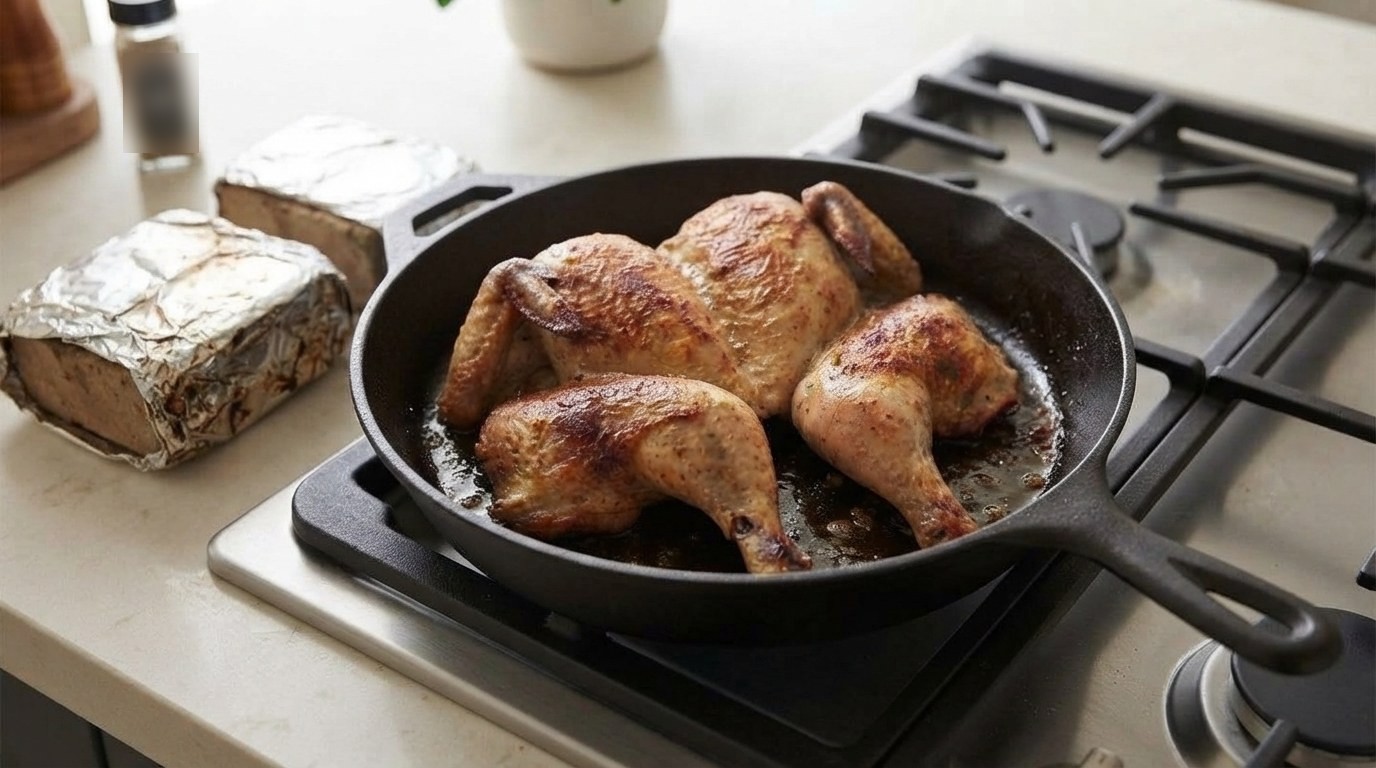
Browning has a temperature floor, and that is the other half of the story. The Maillard reaction, which builds the color and the roasted flavor of good chicken skin, starts at about 284°F (140°C) and peaks around 320°F (160°C). Water cannot get hotter than 212°F (100°C), so as long as the skin is wet it steams instead of browning. The brick helps here as well: by squeezing out the moisture and fat where skin meets iron, it lets the surface dry and climb past 284°F sooner. Keep the burner at medium, though. Above about 356°F (180°C) browning tips into burning, and a bird that sits 20 minutes on a hot pan will scorch if the heat is too high.
The pan matters. A heavy cast-iron skillet holds a lot of heat, so when a cold, 4 lb chicken lands in it the surface temperature dips only a little and recovers fast. A thin pan loses its heat to the bird, the skin sits at a simmer in its own juices, and you get pale, soft spots. A 12-inch skillet is the size that fits a whole spatchcocked chicken lying flat.
Lodge
Lodge 12-Inch Pre-Seasoned Cast Iron Skillet
- Twelve inches across, wide enough for a whole 3½ to 4 lb spatchcocked chicken to lie flat
- Heavy cast iron holds its heat when the cold bird goes in, so the skin keeps browning instead of stewing
- Goes from the burner straight into a 425°F oven; pre-seasoned and made in the USA
Cast iron also goes straight from the burner into the oven for the finish. Look after it the way Lodge recommends: wash it (a little soap is fine), dry it completely, and rub on a thin coat of oil while it is still warm. For more pans that suit this kind of high-heat cooking, see our Gordon Ramsay cookware guide.
How to Spatchcock a Chicken for Brick Chicken
To spatchcock a chicken for brick chicken, set it breast-side down, cut along both sides of the backbone with sturdy kitchen shears, and lift the backbone out. Then turn the bird over, spread it open, and press down hard on the breastbone with the heel of your hand until it cracks and the chicken lies flat. Tuck the wing tips behind the breasts so they do not burn. That is the whole job, and it takes about five minutes.
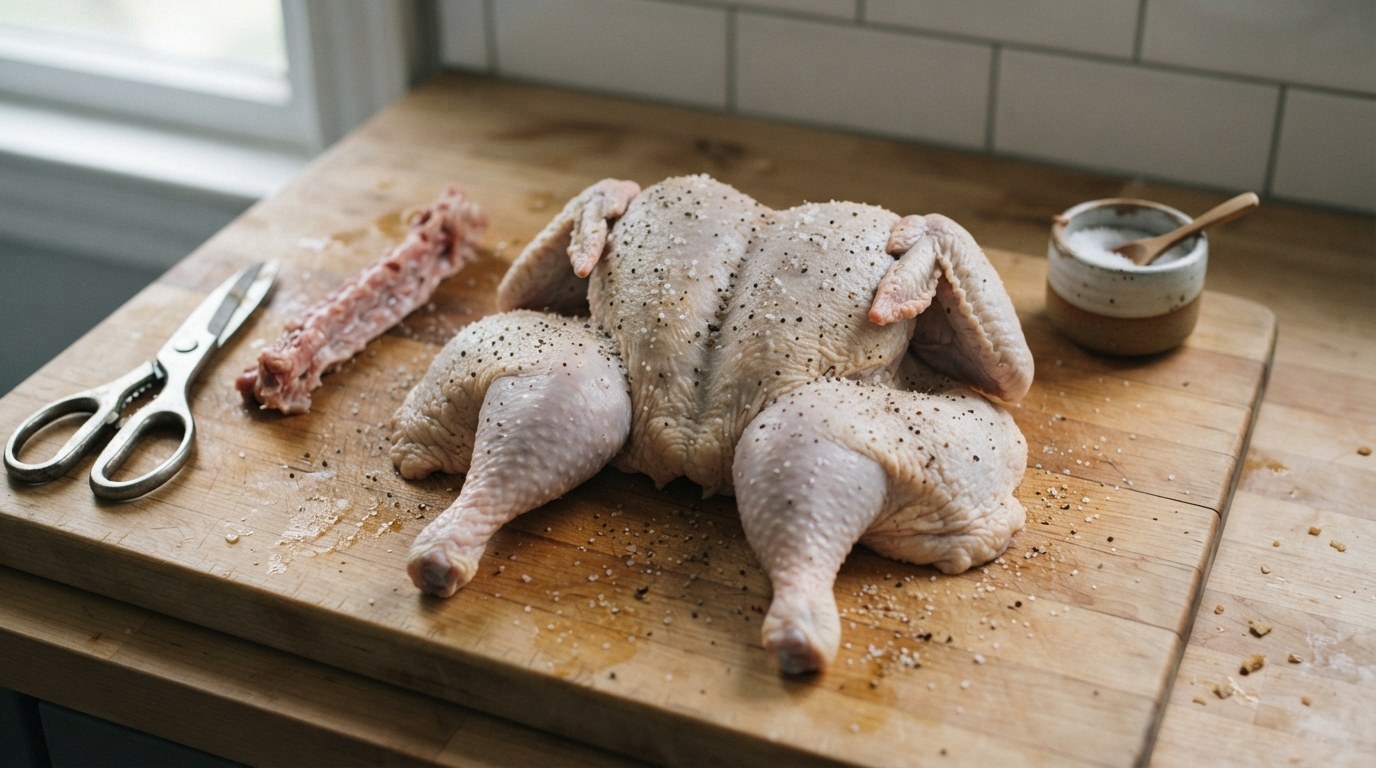
Flattening is what lets the breast and the legs finish at the same time. In a whole roast bird the breast sits highest and most exposed and cooks first, while the thighs are tucked against the body and lag behind, so by the time the legs are done the breast is dry. Breast meat is lean, with almost no fat or connective tissue to keep it moist. Leg meat is the opposite: it is full of collagen, which only melts into soft gelatin after time above about 154°F (68°C). Spread flat to an even thickness, with the thighs on the outside of the pan where the heat is steady, the two cook at nearly the same pace. Do not throw the backbone away. Ramsay's rule is to waste nothing, and the backbone makes a good small batch of stock; our guide to choosing and breaking down a chicken covers the rest of the bird.
Salt the Chicken Ahead and Keep the Skin Dry
Salt brick chicken at least 40 minutes before cooking, and ideally the night before, then leave it uncovered in the fridge. This is a dry brine. Salt is the one seasoning that actually travels into meat: it draws out a little moisture, dissolves in it, and is slowly pulled back in, seasoning the flesh below the surface and loosening the proteins so they hold on to more juice as they cook. A marinade cannot do that; its flavors stay within a few millimeters of the surface. Leaving the bird uncovered on a rack does a second job: cold fridge air dries the skin, and dry skin is what browns. Pat it dry once more right before it goes into the pan.
Do not rinse the chicken first. It does not remove bacteria, it sprays them around the sink. In a USDA study of home cooks, 26 percent of the people who washed raw poultry ended up transferring bacteria from it to the salad lettuce they made next. Pat the bird dry with paper towels instead, then wash your hands, the board and the shears in hot soapy water. Wrap the bricks in fresh foil each time you cook, and throw that foil away afterward, since it has been pressed against raw chicken.
How Long to Cook Brick Chicken, and How to Tell It's Done
A 3½ to 4 lb brick chicken takes about 20 to 25 minutes skin-side down on the stove, then 10 to 15 minutes skin-side up in a 425°F oven. Start the skillet over medium-high heat, lay the bird in skin-side down, set the bricks on top, and turn the burner down to medium. Leave it alone. After 10 minutes, lift a corner: if the skin is already dark brown, lower the heat; if it is still pale, raise it a notch. When the skin is deep golden all over and most of the fat has rendered out, take off the bricks with oven mitts (they are hot), flip the chicken skin-side up, and move the whole skillet to the oven.
Doneness is a thermometer reading, not a time. The USDA safe minimum for chicken is 165°F (74°C), checked in the thickest part of the breast without touching bone. The thighs are better higher, at 175 to 185°F, where their collagen has had time to soften. ThermoWorks recommends about 170 to 175°F for leg meat for the same reason, and notes that meat right at the bone can look pink even when it is fully cooked, because pigment from the marrow seeps through a young chicken's porous bones. Go by the number. Our oven thermometer guide explains why your oven dial may be off, which is worth knowing for the finish.
| Where you check | Pull it at | Why |
|---|---|---|
| Thickest part of the breast | 165°F (74°C) | USDA safe minimum for all poultry |
| Thickest part of the thigh, off the bone | 175 to 185°F | Collagen has softened; the meat is tender, not chewy |
| After a 10-minute rest | Rises a few degrees | Carryover heat keeps cooking the center |
Resting and Carving Brick Chicken
Rest brick chicken skin-side up on a board for 10 minutes before you carve it, and leave it uncovered so the skin stays crisp. Two things happen in that time. Carryover heat moves from the hot outside to the cooler center, so the internal temperature keeps rising a few degrees after it leaves the oven. And the juices cool slightly and thicken, so less of them runs out when you cut. Resting does not relax the muscle, as the old explanation goes; it is the thicker juice that stays put. Steak shows the effect clearly: cut after 2 minutes it loses around 6 percent of its weight, after 10 minutes about 2 percent.
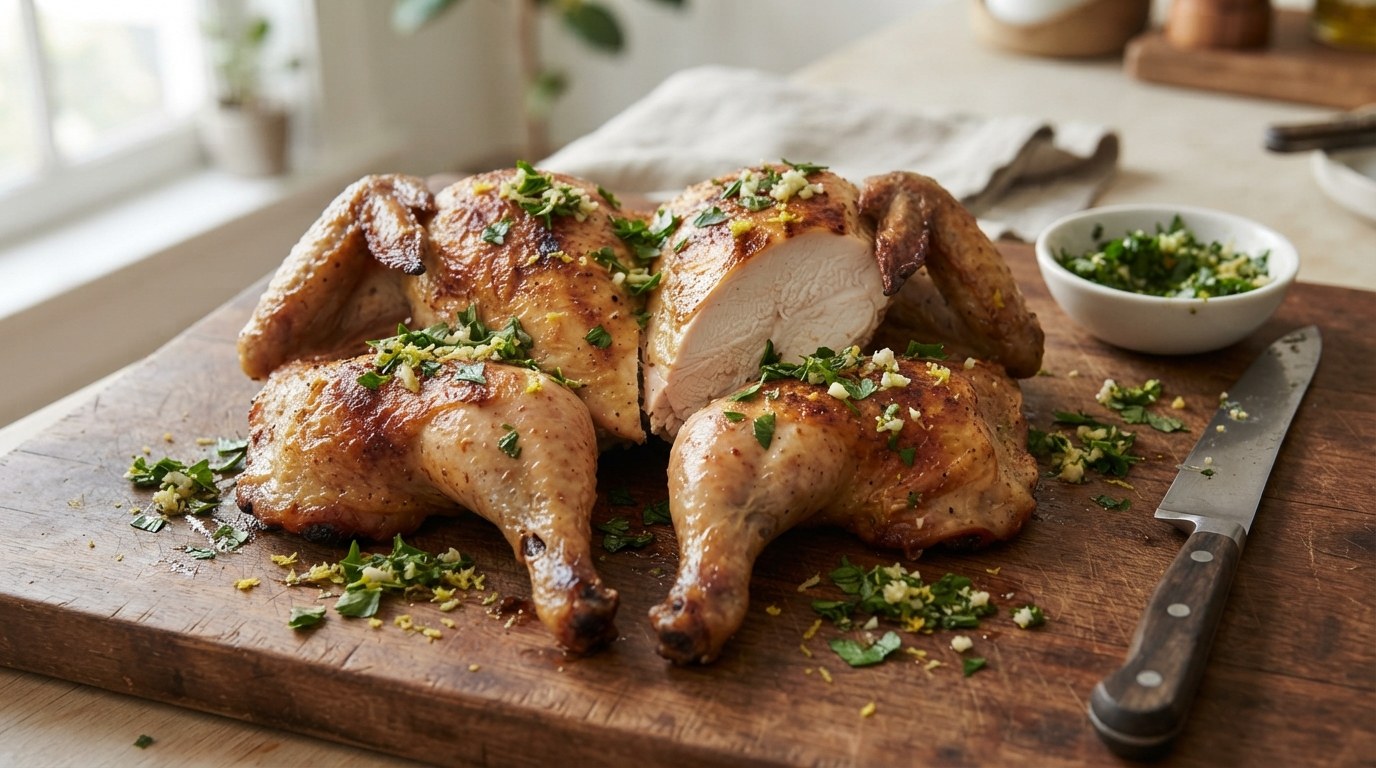
To carve, cut straight down through the breastbone to split the bird into halves, then cut each half between the breast and the thigh into a breast-and-wing piece and a leg quarter. Four pieces, four servings. Spoon the gremolata over just before it goes to the table.
Herb Gremolata: What It Is and Why It Goes On Last
Gremolata is a raw Italian topping of finely chopped flat-leaf parsley, grated lemon zest and minced garlic, best known on osso buco. This herb gremolata adds a spoonful of olive oil and a squeeze of lemon juice so it spoons over the chicken in loose, glossy crumbs. It goes on at the end, raw, because every one of its flavors fades with heat.
Each part has its own job against rich, fatty chicken skin. Raw garlic's bite comes from allicin, which only forms when the clove is cut: the Linus Pauling Institute at Oregon State University explains that crushing releases an enzyme, alliinase, that makes it within 10 to 60 seconds, and that heat shuts the enzyme down. That is why cooked garlic turns mellow and sweet while raw garlic stays sharp. The fragrance of lemon zest lives in volatile oils in the yellow peel that evaporate when warmed, so grate only the yellow layer, never the bitter white pith, and add it last. The lemon juice's acid and the fresh, grassy parsley cut through the fat the way a squeeze of lemon does on fried fish. Make the gremolata while the chicken is in the oven and use it within an hour, before the parsley darkens and the zest goes dull.
How to Make Brick Chicken on the Grill
To make brick chicken on the grill, set up a two-zone fire with one side on medium-high (around 400 to 450°F under the lid) and the other side off or low. Lay a half chicken or a whole spatchcocked bird skin-side down over the hot side, press it flat, and set two foil-wrapped bricks on top. Grill it for 12 to 15 minutes, until the skin is well marked and golden and releases from the grates on its own. Flip it, put the bricks back on, and move it to the cooler side with the lid closed for another 15 to 20 minutes, until the breast reads 165°F and the thighs 175°F or more.
Two grill problems are worth heading off. Dripping fat causes flare-ups that blacken the skin in seconds, so keep a cooler zone to slide the bird to, and do not walk away during the first side. And grill grates are only lines of contact, so a grilled brick chicken gets bold char stripes rather than the even, all-over crust of the skillet version. Clean, oiled grates help the skin release instead of tearing.
Brick Chicken Troubleshooting and What to Serve With It
Most brick chicken problems trace back to moisture or heat. Pale, flabby skin means it went in wet or the pan was too cool; dry it harder and give the skillet its full preheat. Skin that sticks and tears means it was moved too early: browned skin releases on its own, so wait. Dark, bitter spots mean the burner was too high for the long cook on the stove; medium is plenty once the bricks are on. A breast that reaches 165°F well before the thighs usually means the bird was not pressed flat enough at the breastbone. A deep pool of fat can be carefully spooned out partway through, but leave a thin layer, since it is what fries the edges.
For sides, take a hint from the Hell's Kitchen lunch plate and serve brick chicken with a pile of arugula and thinly shaved raw fennel dressed with lemon and olive oil, which echoes the gremolata. For something more filling, Yukon Gold mashed potatoes soak up the pan juices, and wilted sauteed spinach cooks in the time the chicken rests. Leftovers keep 3 to 4 days in the fridge; reheat pieces skin-side up in a 375°F oven until they are hot through to 165°F, which crisps the skin again.
Brick chicken is one of the best ways to get crisp skin and evenly cooked meat from a whole bird on a weeknight. If it becomes a regular, try the same pressed-skin idea on fish with our crispy skin salmon, or work through bone-in breasts with the bone-in chicken breast guide. Every other poultry dish from the Ramsay kitchen is collected in our best Hell's Kitchen chicken recipes.
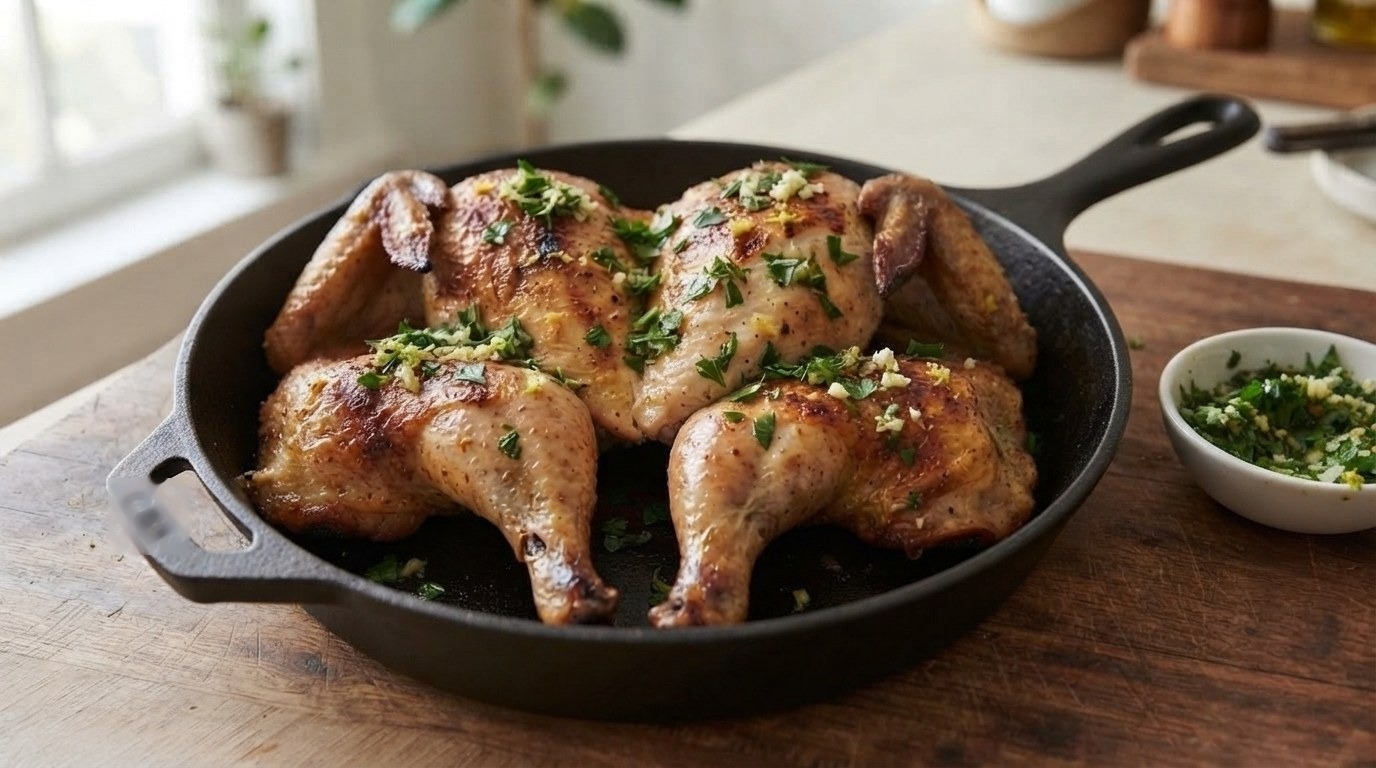
Brick Chicken with Herb Gremolata
Ingredients
Brick chicken
- 1 whole chicken (3½ to 4 lb), patted dry
- 1 tbsp Diamond Crystal kosher salt (or 2 tsp Morton kosher salt)
- 1 tsp freshly ground black pepper
- 1 tbsp grapeseed or vegetable oil
Herb gremolata
- 1/2 cup lightly packed flat-leaf parsley leaves, finely chopped
- 1 lemon, zest finely grated and juice of half
- 2 garlic cloves, very finely minced
- 1 tbsp extra-virgin olive oil
- pinch of flaky sea salt
Instructions
- Spatchcock the chicken: set it breast-side down and cut along both sides of the backbone with kitchen shears. Remove the backbone (freeze it for stock). Turn the bird over, open it out and press firmly on the breastbone until it cracks and the chicken lies flat. Tuck the wing tips behind the breasts. Pat dry with paper towels; do not rinse it.
- Season all over with the kosher salt and pepper, a little more on the thick breast and thighs. Set it skin-side up on a rack over a plate or sheet pan and refrigerate uncovered for at least 40 minutes, ideally overnight (up to 24 hours). Wash your hands, board and shears in hot soapy water.
- Take the chicken out 30 minutes before cooking. Heat the oven to 425°F with a rack in the middle. Wrap two bricks in a double layer of foil. Pat the skin dry again.
- Heat a 12-inch cast-iron skillet over medium-high heat for 4 to 5 minutes. Add the oil, and when it shimmers, lay the chicken in skin-side down. Press it flat and set the foil-wrapped bricks on top, spreading the weight over the breasts and thighs. Turn the heat down to medium.
- Cook without moving it for 20 to 25 minutes, until the skin is deep golden-brown and crisp and most of the fat has rendered. Check after 10 minutes by lifting a corner: if it is browning too fast, lower the heat; if it is pale, raise it slightly.
- Meanwhile, make the gremolata: mix the parsley, lemon zest, garlic, olive oil, a squeeze of the lemon juice and a pinch of flaky salt in a small bowl.
- Using oven mitts, lift off the hot bricks. Flip the chicken skin-side up with tongs and a spatula and move the skillet to the oven. Roast for 10 to 15 minutes, until the thickest part of the breast reads 165°F and the thighs 175 to 185°F.
- Transfer the chicken skin-side up to a board and rest, uncovered, for 10 minutes. Cut it through the breastbone into halves, then each half into a breast piece and a leg quarter. Spoon the gremolata over just before serving.
Notes
Brick Chicken FAQs
The questions that come up most: what brick chicken is, why it is called chicken under a brick, whether it has bones, how long to cook it, how to make it without a brick, whether you can cook it in the oven, what gremolata is made of, and what to serve with it.
What is brick chicken?
Brick chicken, or pollo al mattone in Italian, is a whole chicken with the backbone removed, pressed flat, and cooked skin-side down under a weight such as a foil-wrapped brick. The weight keeps all of the skin against the hot pan or grill, so it renders and crisps evenly while the meat cooks through at the same rate.
Why is it called chicken under a brick?
Because a brick is the traditional weight. The Italian name, pollo al mattone, means chicken under a brick or tile, and the method goes back to a heavy tile set over a bird cooking in a terracotta pan. Today most cooks wrap ordinary bricks in foil, or use a second heavy skillet.
Does brick chicken have bones?
Usually yes. Spatchcocking removes only the backbone and cracks the breastbone so the bird lies flat; the leg, thigh and wing bones stay in. Some restaurants debone the thighs or serve a half chicken, but a classic home brick chicken is bone-in.
How long do you cook brick chicken?
For a 3½ to 4 lb chicken, about 20 to 25 minutes skin-side down under the bricks over medium heat, then 10 to 15 minutes skin-side up in a 425°F oven. It is done when the thickest part of the breast reads 165°F and the thighs 175 to 185°F, then it rests for 10 minutes.
How do you make brick chicken without a brick?
Set a second heavy skillet, ideally cast iron, on top of the chicken and load it with a few cans or a pot of water for weight. A heavy Dutch oven works too. Whatever you use, wrap the bottom in foil if it will touch the raw chicken, and press it down so the bird stays flat.
Can you make brick chicken in the oven?
You need the stovetop for the crisp skin, because the weight only helps where the skin touches a hot surface. The oven is used to finish it: once the skin is deep golden after 20 to 25 minutes in the skillet, flip the chicken skin-side up and roast it at 425°F for 10 to 15 minutes until it reaches temperature.
What is gremolata made of?
Classic gremolata is finely chopped flat-leaf parsley, grated lemon zest and minced raw garlic. This herb gremolata adds a little olive oil and lemon juice so it spoons over the chicken. Make it while the chicken finishes and add it just before serving, since heat dulls the zest and mellows the garlic.
What do you serve with chicken under a brick?
Something fresh and something starchy. Arugula and shaved fennel with lemon and olive oil, as Hell's Kitchen in Washington, DC serves it, keeps it light; mashed potatoes, roasted potatoes or crusty bread soak up the pan juices; and sauteed spinach or green beans round out the plate.

About the Author
John Siracusa is the founder of Hell’s Kitchen Recipes. He focuses on technique-first, reproducible home cooking and researches recipes & kitchen equipment from published food science and professional chef methods since 2016.