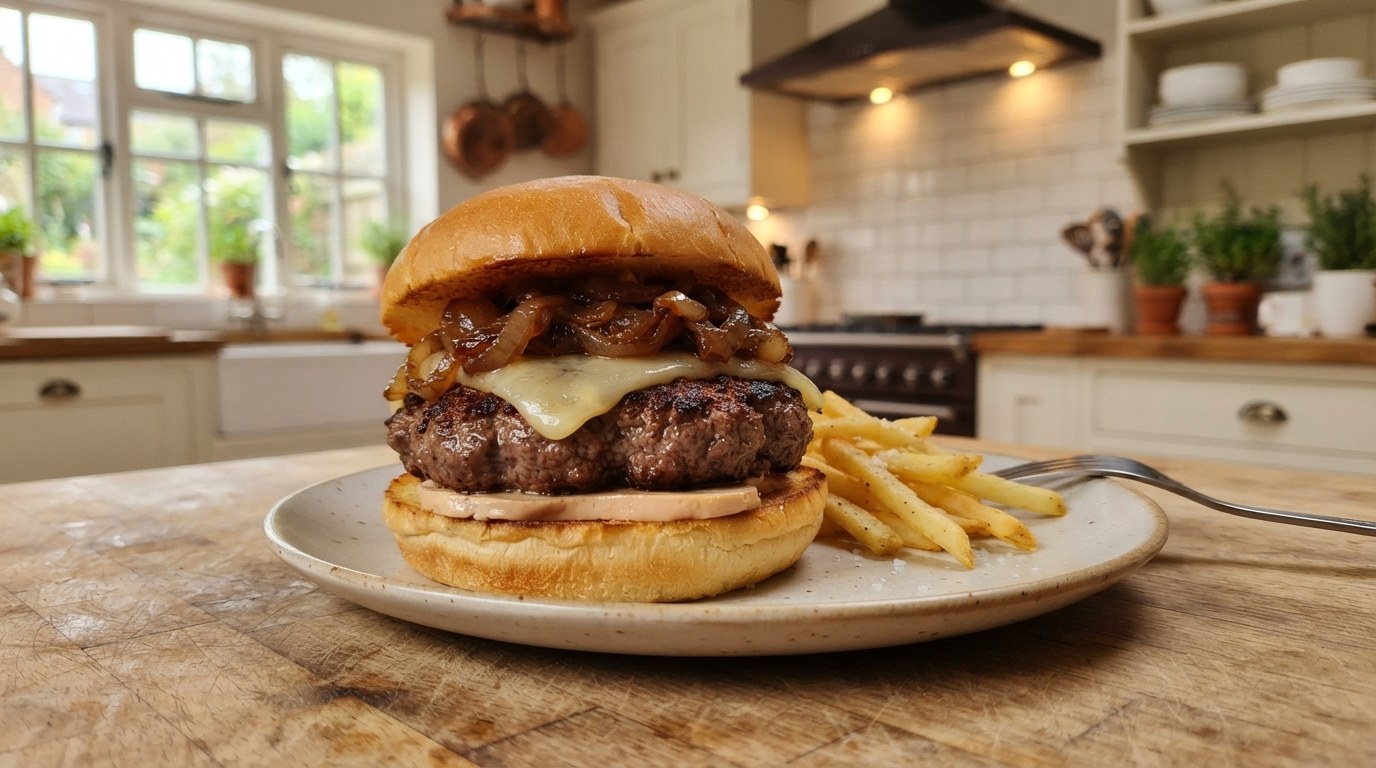
The Gordon Ramsay Luxe Royale burger is the big one on the Gordon Ramsay Burger menu: a 10-ounce wagyu patty, melted Dubliner cheese, caramelized onions and a foie gras spread. Four parts, no lettuce, no sauce. This is that burger made for a home kitchen, and because there is so little on it, each layer has to be right: onions cooked low until jammy, a thick patty taken to a safe 160°F without drying out, cheese that melts instead of sweating oil, and a bun toasted hard enough to stand up to all that fat.
What's on the Luxe Royale Burger?
The Luxe Royale burger is a 10-ounce wagyu beef patty with Dubliner cheese, caramelized onion and foie gras spread, listed that way under Specialties on the Gordon Ramsay Burger Las Vegas menu and served with fries. It is the only burger in that section built on the wagyu patty from the start; on the others, the 10-ounce wagyu is an upgrade you pay extra for. Here is what each layer brings and how to handle it at home.
| Layer | What it adds | Home version | The one thing to get right |
|---|---|---|---|
| 10 oz wagyu patty | Soft, rich beef fat and a thick, juicy bite | Ground American wagyu, formed cold into 1-inch patties | Cook to 160°F; sear, then finish under a lid |
| Dubliner cheese | Sweet, nutty sharpness that cuts the richness | Kerrygold Dubliner, grated or thinly sliced | Melt it with steam so it flows instead of oiling out |
| Caramelized onion | Sweetness and a soft, jammy texture | Yellow onions cooked low for 35 to 45 minutes | Low heat and patience; a splash of water when they catch |
| Foie gras spread | A silky, savory layer under the patty | Ready-to-eat foie gras mousse beaten with a little butter | Soften it so it spreads without tearing the bun |
| Toasted bun | Structure and a crisp face | Brioche or potato buns toasted in the rendered wagyu fat | Toast the cut sides until golden and dry |
Read across the last column and the whole burger is about heat control. Next to the Gordon Ramsay truffle burger or the Celebration burger, the Luxe Royale has fewer toppings and a bigger patty, so there is nothing to hide a mistake behind. The full lineup lives in our guide to Gordon Ramsay's signature burgers.
How to Caramelize Onions for the Luxe Royale Burger
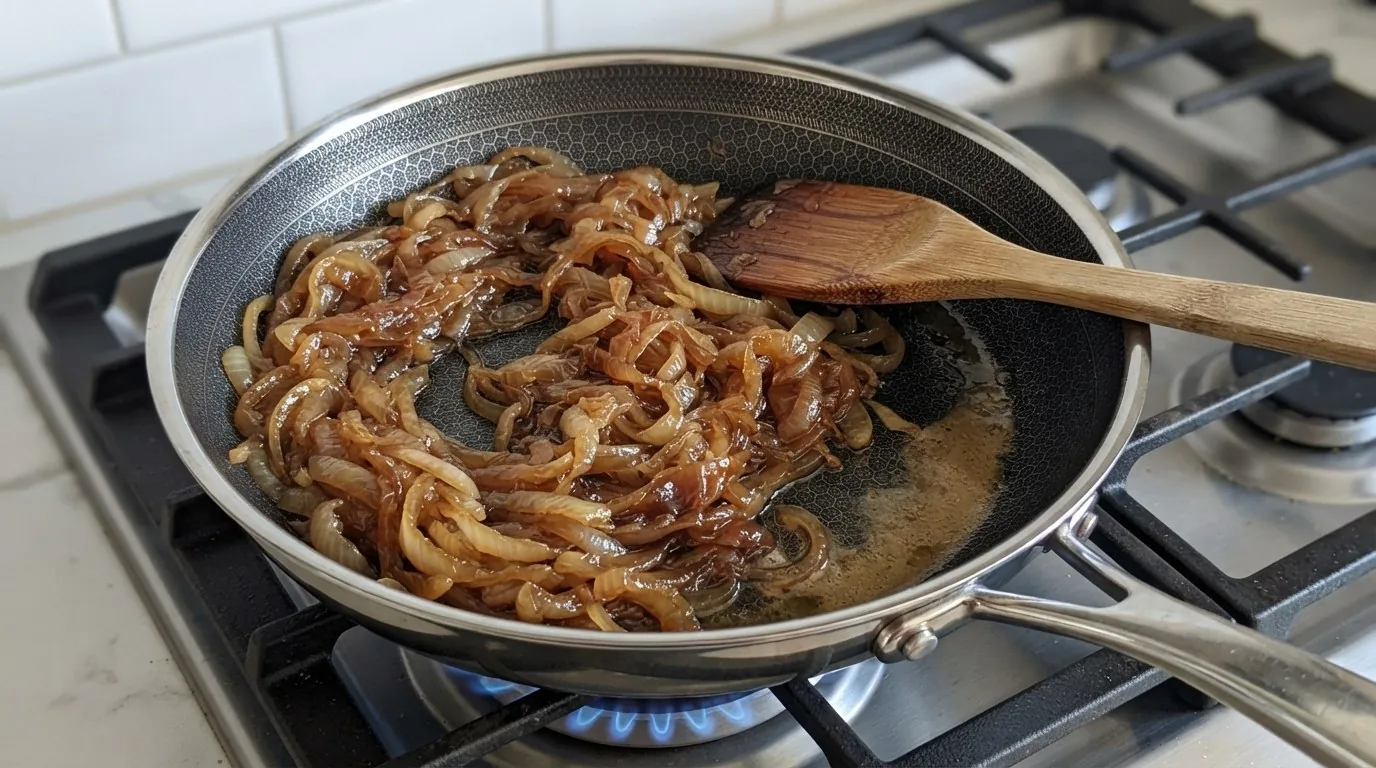
Caramelized onions for this burger take 35 to 45 minutes over low to medium-low heat, and there is no shortcut that tastes the same. Mississippi State University Extension puts it at 30 to 40 minutes on low and suggests a wide pan and a lid to hold moisture in so the onions don't dry out and burn. Start them first; they can sit warm while everything else cooks.
Onions are mostly water, and water can't get hotter than 212°F (100°C), so nothing browns until most of it has cooked off. That's why the first ten minutes go under a lid on low: the slices sweat, soften and collapse. Then the lid comes off, the heat goes to medium, and the browning starts. The National Onion Association explains that the onion's sucrose splits into fructose, which begins to caramelize at 230°F, and glucose, which follows at 320°F. The onions also carry amino acids, so the Maillard reaction joins in once the surface passes about 284°F. That mix is where the deep, savory sweetness comes from.
The danger zone is past 356°F, where sugars stop browning and start burning bitter. When the brown film on the pan floor turns dark, add a tablespoon of water and scrape; the NOA recommends exactly this to dissolve the sugars before they scorch, and the onions soak that flavor back up. Slice the onions from root to tip so the strands hold their shape on the burger, and finish with a small knob of butter for gloss. A 12-inch pan gives them room to spread out, and the same pan sears the patties later.
HexClad
HexClad 12-Inch Hybrid Nonstick Frying Pan
- Stainless steel and ceramic nonstick hybrid surface, built to sear hard and release easily
- Tri-ply with an aluminum core for quick, even heat; works on induction
- Oven safe to 900°F and metal-utensil safe (lid not included)
Make them ahead if you like. Caramelized onions keep up to 5 days in the fridge, per the NOA, and reheat in a minute. For another dish built on the same slow onion work, try our Gordon Ramsay French onion soup.
Cooking a 10-Ounce Wagyu Patty to 160°F
Cook the wagyu patty to 160°F in the center, the USDA safe minimum for ground beef. Wagyu's marbling doesn't change that number, because grinding spreads whatever was on the surface through the meat. The fat does change how you handle it, and it's the reason a patty this thick can reach 160°F and still eat juicy.
Wagyu fat melts at a lower temperature than ordinary beef fat. Texas A&M's Department of Animal Science notes that it melts below human body temperature, and its research on marbling ties that softness to the high level of oleic acid in the fat. In practice, warm hands smear it. Keep the ground wagyu in the fridge until you form the patties, shape them quickly about an inch thick and 4 1/2 inches wide, and put them straight back in the fridge until the pan is hot.
Heat the pan first, then add a little grapeseed oil, and lay the patties in with space between them. Sear 4 minutes without moving them, flip, and give them 3 more; both sides need a hard brown crust. Wagyu renders a lot of fat quickly, so tip most of it into a heatproof bowl and keep a tablespoon for the buns. Then turn the heat down to medium-low for the finish. A skillet is kinder than a grill here, since all that dripping fat on a grill feeds flare-ups that char the outside while the middle lags.
Use a thermometer, not color. The USDA reports that 1 in 4 hamburgers turns brown in the middle before it reaches a safe temperature, and a patty this thick hides a cool center well.
Melting Dubliner Cheese on a Thick Patty
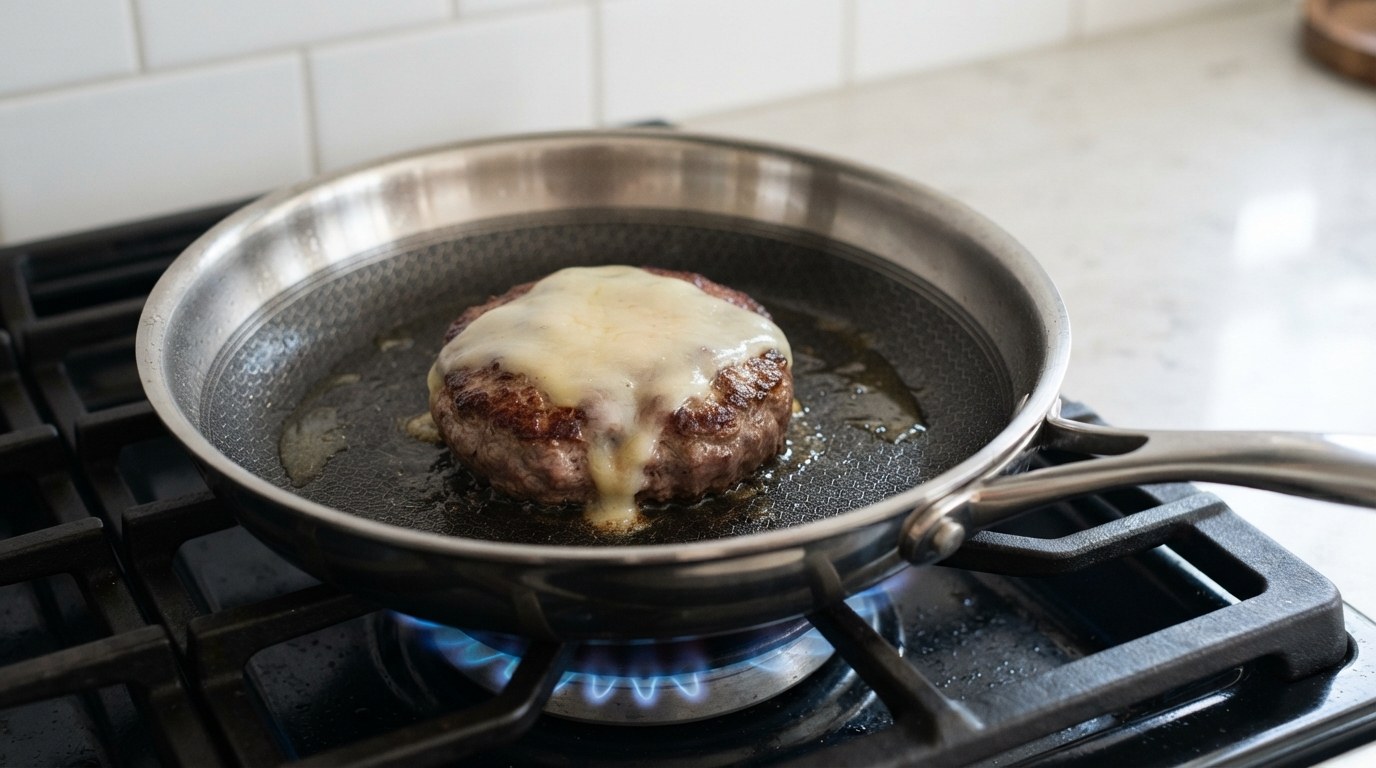
Melt the Dubliner under a lid with a splash of water in the pan during the last few minutes of cooking. Kerrygold describes Dubliner as an aged cow's milk cheese with a hard texture similar to cheddar and a sweet, nutty flavor, and aged, drier cheeses melt in a particular way. Their milkfat softens around 90°F, while the protein holding them together needs far more heat before it lets go and flows, closer to 180°F. Warm one slowly in dry air and the fat runs out first, leaving an oily, rubbery slice.
Steam fixes that. Once the patties are flipped and seared, lay the cheese on, add a tablespoon of water to the pan away from the meat and cover. The trapped steam wraps the cheese in moist heat and melts it evenly in 1 to 2 minutes, while the patty finishes climbing to 160°F underneath. Grate the Dubliner coarsely or slice it thin; more surface means a faster melt. If you prefer a crisp, lacy edge to a soft blanket, melt it on the pan instead, the way our guide on how to melt cheese on a burger shows.
Foie Gras Spread and a Toasted Bun: Keeping the Luxe Royale Burger From Going Soggy
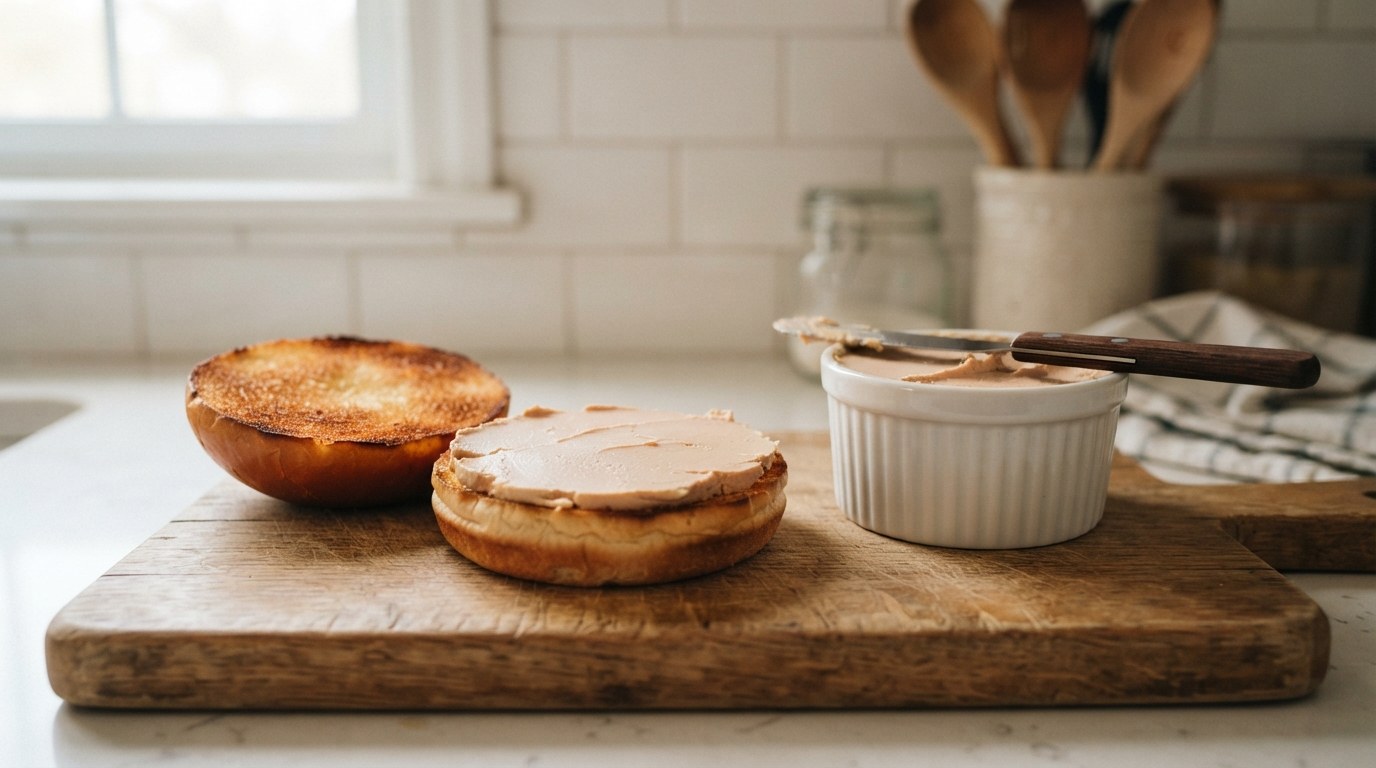
A Luxe Royale burger stays intact when the bun is toasted dry and the foie gras spread sits between the bread and the patty. With this much fat and juice coming off a wagyu patty, an untoasted bun turns to paste before you're halfway through. Toast the cut sides in that saved tablespoon of wagyu fat over medium heat for 1 to 2 minutes. The pan face is well past 284°F, so the crumb browns, loses surface moisture and firms into a crisp layer that juice can't soak straight into. It also puts the beef flavor back into the bread instead of down the drain.
Use a ready-to-eat foie gras mousse, parfait or torchon for the spread; these are already cooked. Raw foie gras needs cooking and won't spread anyway. Foie gras is mostly fat, so like butter it spreads cleanly only once it has softened: leave it on the counter for 20 to 30 minutes, then beat it with a tablespoon of soft butter and a pinch of salt until smooth. Spread it on the bottom bun. Because it's fat, it also repels the patty's juices and keeps the toasted bottom crisp a little longer.
Let the patties rest for 3 minutes before they go on. Resting doesn't relax the meat; it lets the juices cool and thicken slightly so less of them runs out at the first bite, and carryover heat nudges the center a degree or two higher. Then stack it: foie gras on the bottom bun, the cheese-topped patty, a heap of warm onions, the top bun.
Swaps and Variations
The easiest swap is the foie gras. A smooth chicken liver pâté gives the same savory, silky layer, and softened butter whipped with a spoonful of the chopped caramelized onions works if you'd rather skip liver entirely. If you can't find Dubliner, an aged white cheddar or Gruyère melts the same way under steam and keeps the nutty edge. Any good 80/20 ground chuck stands in for wagyu; it's leaner, so expect a little less fat in the pan and a slightly firmer bite. For smaller appetites, make six 6-ounce patties about 3/4 inch thick and cut the covered finishing time roughly in half, still cooking them to 160°F.
What to Serve With the Luxe Royale Burger
Serve the Luxe Royale burger the way the restaurant does, with fries; the menu lists truffle parmesan fries, beer-battered onion rings or a side salad as swaps. A salad with a sharp vinaigrette is the smart choice here, since the burger already carries plenty of richness. For the next burger night, try the slow-braised 24-hour burger or the stout burger, and read up on Kobe beef vs wagyu before you shop for the meat. Cook the onions low, take the patty to 160°F, toast the bun hard, and the Gordon Ramsay Luxe Royale burger comes out of a home kitchen tasting like the real thing.
Gordon Ramsay Luxe Royale Burger
Ingredients
Caramelized onions
- 3 large yellow onions (about 2 lb), halved and thinly sliced root to tip
- 2 tbsp neutral oil
- 1/2 tsp kosher salt
- 1 tbsp unsalted butter
- Water, a tablespoon at a time as needed
Foie gras spread
- 4 oz ready-to-eat foie gras mousse, parfait or torchon (115 g)
- 1 tbsp unsalted butter, softened
- Pinch of flaky salt and black pepper
Burgers
- 2 1/2 lb ground American wagyu beef (1.1 kg), kept cold
- Kosher salt and freshly ground black pepper
- 1 tbsp grapeseed oil
- 4 oz Dubliner cheese, coarsely grated or thinly sliced (115 g)
- 4 brioche or potato burger buns, split
- Fries, to serve
Instructions
- Heat the neutral oil in a 12-inch skillet over low heat. Add the onions and salt, cover, and cook for about 10 minutes, stirring once or twice, until soft and translucent.
- Uncover, raise the heat to medium and cook for 25 to 35 minutes, stirring every few minutes and lowering the heat as they darken, until deep amber and jammy. When the pan floor browns, add a tablespoon of water and scrape it up. Stir in the butter, transfer to a bowl and keep warm. Wipe out the skillet.
- Take the foie gras out of the fridge 20 to 30 minutes ahead. Beat it with the softened butter, salt and pepper until smooth and spreadable.
- Divide the cold wagyu into four 10 oz portions and shape each loosely into a patty about 1 inch thick and 4 1/2 inches wide. Refrigerate until the pan is ready. Season both sides with salt and pepper just before cooking.
- Heat the skillet over medium-high until hot, then add the grapeseed oil. Add the patties (in two batches if they would touch) and sear without moving for 4 minutes. Flip and sear 3 minutes more.
- Pour off most of the rendered fat into a heatproof bowl, saving 1 tablespoon. Lower the heat to medium-low, top each patty with cheese, add 1 tablespoon of water to the pan away from the meat and cover. Cook 4 to 6 minutes, until the cheese is melted and an instant-read thermometer in the center of each patty reads 160°F.
- Move the patties to a plate and rest 3 minutes. Meanwhile, heat the saved wagyu fat in a clean skillet over medium and toast the buns cut side down for 1 to 2 minutes, until golden and crisp.
- Spread the foie gras on the bottom buns, add the patties, pile on the warm caramelized onions and close with the top buns. Serve with fries.
Notes
Luxe Royale Burger FAQs
The questions that come up most: what is on the Luxe Royale burger, how long to cook a thick wagyu burger, what temperature it needs, how long the onions take, what Dubliner cheese is, how to make it without foie gras, and how to keep the bun from going soggy.
What is on the Gordon Ramsay Luxe Royale burger?
A 10-ounce wagyu beef patty, Dubliner cheese, caramelized onion and foie gras spread on a bun, served with fries. That is how it is listed on the Gordon Ramsay Burger Las Vegas menu.
How long do you cook a thick wagyu burger?
For a 10-ounce patty about an inch thick, sear 4 minutes, flip and sear 3 minutes, then cover and cook over medium-low for about 4 to 6 minutes more, until a thermometer in the center reads 160°F. Plan on 12 to 14 minutes in total.
What temperature should a wagyu burger be cooked to?
160°F in the center, the USDA minimum for all ground beef. Wagyu marbling does not change it, and color is not a reliable guide, so check with an instant-read thermometer.
How long does it take to caramelize onions for burgers?
About 35 to 45 minutes: roughly 10 minutes covered on low to soften, then 25 to 35 minutes uncovered over medium to medium-low, stirring and adding a splash of water when the pan browns. They keep up to 5 days in the fridge.
What is Dubliner cheese, and what can I use instead?
Dubliner is an aged Irish cow's milk cheese sold by Kerrygold, with a firm, cheddar-like texture and a sweet, nutty flavor. An aged white cheddar or Gruyère is the closest swap.
Can you make the Luxe Royale burger without foie gras?
Yes. Smooth chicken liver pâté gives a similar silky, savory layer, or whip softened butter with a spoonful of chopped caramelized onions. Either way, spread it on the toasted bottom bun.
How do you keep a burger bun from getting soggy?
Toast the cut sides in a little fat until golden and dry, spread a fat layer such as the foie gras on the bottom bun, and rest the patty 3 minutes before building so fewer juices run into the bread.

About the Author
John Siracusa is the founder of Hell’s Kitchen Recipes. He focuses on technique-first, reproducible home cooking and researches recipes & kitchen equipment from published food science and professional chef methods since 2016.