Gordon Ramsay's carbonara is a ten-minute pan of spaghetti, crisp pancetta, garlic, sliced mushrooms and a little chili, finished off the heat with egg yolks, grated Grana Padano and a spoonful of crème fraîche, with peas and parsley thrown in at the end. It is not the Roman original, and Ramsay has never claimed it is; it is a weeknight version built for speed that keeps the one thing that makes carbonara carbonara, a sauce made from egg yolks and cheese thickened by the heat of the pasta rather than by cream. This page is his recipe, published on his own site for a single portion, scaled to feed four, with the technique explained so the sauce comes out silky rather than scrambled.
The guide covers how Ramsay's version differs from the Roman one and why, what happens to the pancetta and the garlic in the pan, the temperatures at which egg yolks set and how the cheese, crème fraîche and pasta water keep them from doing it too soon, the off-the-heat toss, and the pea question. It sits in the site's recipes with the other pasta: Ramsay's Alfredo sauce, his bolognese, the fresh pasta dough from his MasterClass, and the vegetarian carbonara for the meatless version of this dish.
Ramsay's Carbonara vs the Roman Original
The Roman dish is four ingredients and a pot of water: guanciale, eggs, Pecorino Romano and black pepper, tossed with pasta, and nothing else. Ramsay's carbonara in under 10 minutes, as published on his site, swaps guanciale for streaky bacon or pancetta, Pecorino for Grana Padano or Parmesan, whole eggs for yolks only, and adds crème fraîche, garlic, mushrooms, chili, peas and parsley. Purists in Rome have called it a lot of things, and it is fair to say that a Roman cook would not recognize the mushrooms and peas. It is also fair to say that the additions each do a job: garlic and chili season the fat the pasta will be tossed in, mushrooms add bulk to a dish that is otherwise mostly starch and pork, the crème fraîche is insurance against the sauce splitting, and the peas are Ramsay's signature, discussed below.
| Element | Roman carbonara | Ramsay's 10-minute carbonara | What the swap changes |
|---|---|---|---|
| Pork | Guanciale (cured jowl) | Streaky bacon or pancetta (cured belly) | Less rendered fat, milder flavor; bacon adds smoke |
| Cheese | Pecorino Romano (sheep's milk) | Grana Padano or Parmesan (cow's milk) | Softer, nuttier, less salty |
| Egg | Whole eggs plus extra yolks | Yolks only, 2 per portion | Richer, less likely to turn watery |
| Dairy | None | 1½ tbsp crème fraîche per portion | Fat that stabilizes the emulsion under heat |
| Aromatics | Black pepper only | Garlic, red chili, parsley | Seasoned fat; heat |
| Vegetables | None | Sliced mushrooms, frozen peas | Bulk, sweetness, color |
The Pancetta, Garlic, Mushrooms and Chili
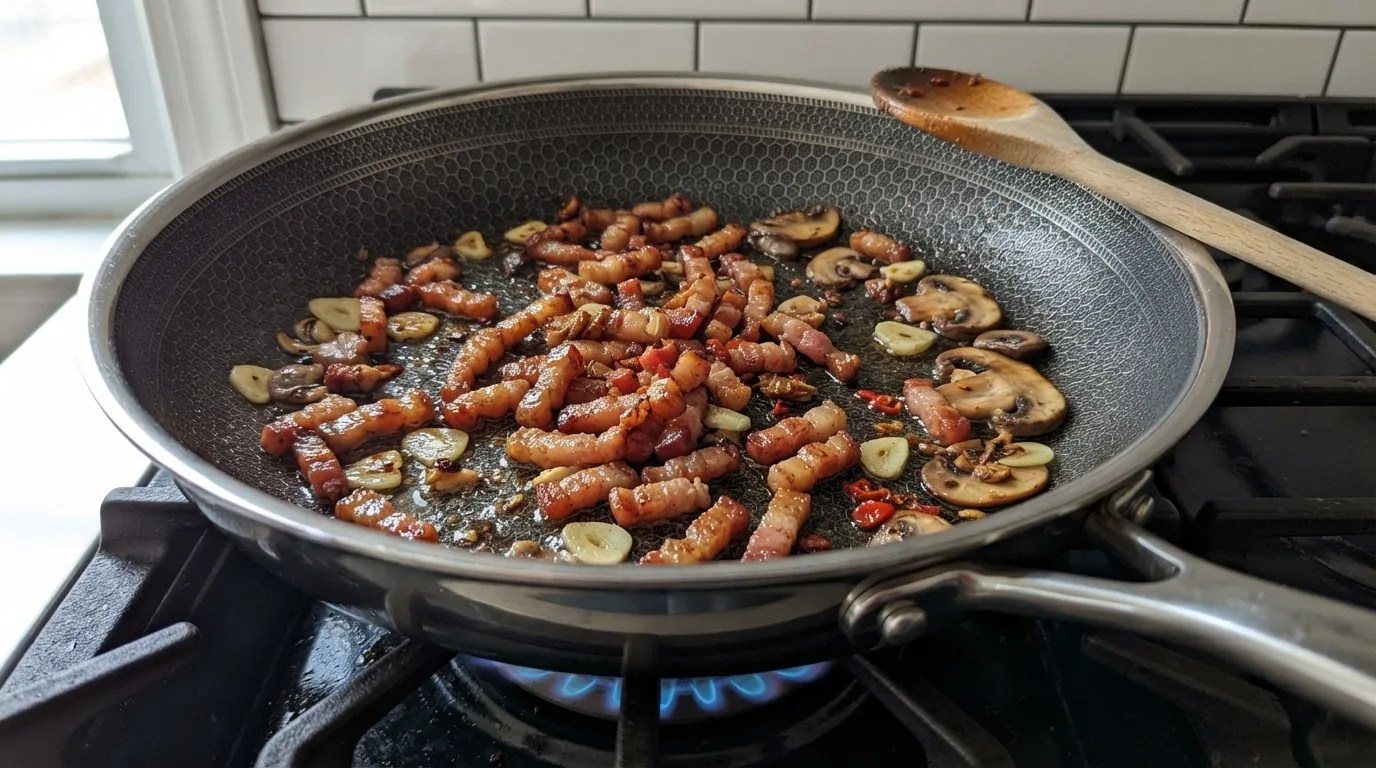
The pancetta goes into a hot pan with a little olive oil first and alone, and it needs those first two minutes to itself because its fat has to render before anything can brown. Pancetta is cured pork belly, roughly half fat by weight, and as the pan heats the fat liquefies and runs out, leaving the lean lardons frying in it; only once their surface is dry and the fat is above 284°F does the Maillard reaction start and turn them golden and crisp. Ramsay grinds pepper over the pancetta at this stage rather than at the end, which lets the pepper's oils bloom in the hot fat. The garlic goes in after two minutes, not at the start, because sliced garlic scorches in under a minute in fat that hot; its sugars caramelize and then burn bitter above roughly 356°F, and burnt garlic ruins the whole pan.
Mushrooms and chili follow the garlic. Sliced mushrooms are about 90 percent water, so they hiss, release liquid and only start to color once that water has boiled off and their surfaces dry, which is the same rule as the pancetta; in a crowded pan they steam grey instead. The chili, minced, needs only a minute. By the time the pancetta is crisp and the mushrooms have taken color, about five minutes in, the pan holds seasoned pork fat, and that fat is the base the pasta will be tossed in. Ramsay uses a nonstick pan for this, which matters less for the browning than for the next step, when egg is going to hit a warm surface.
The Yolks, Cheese and Crème Fraîche: Why the Sauce Sets at 158°F
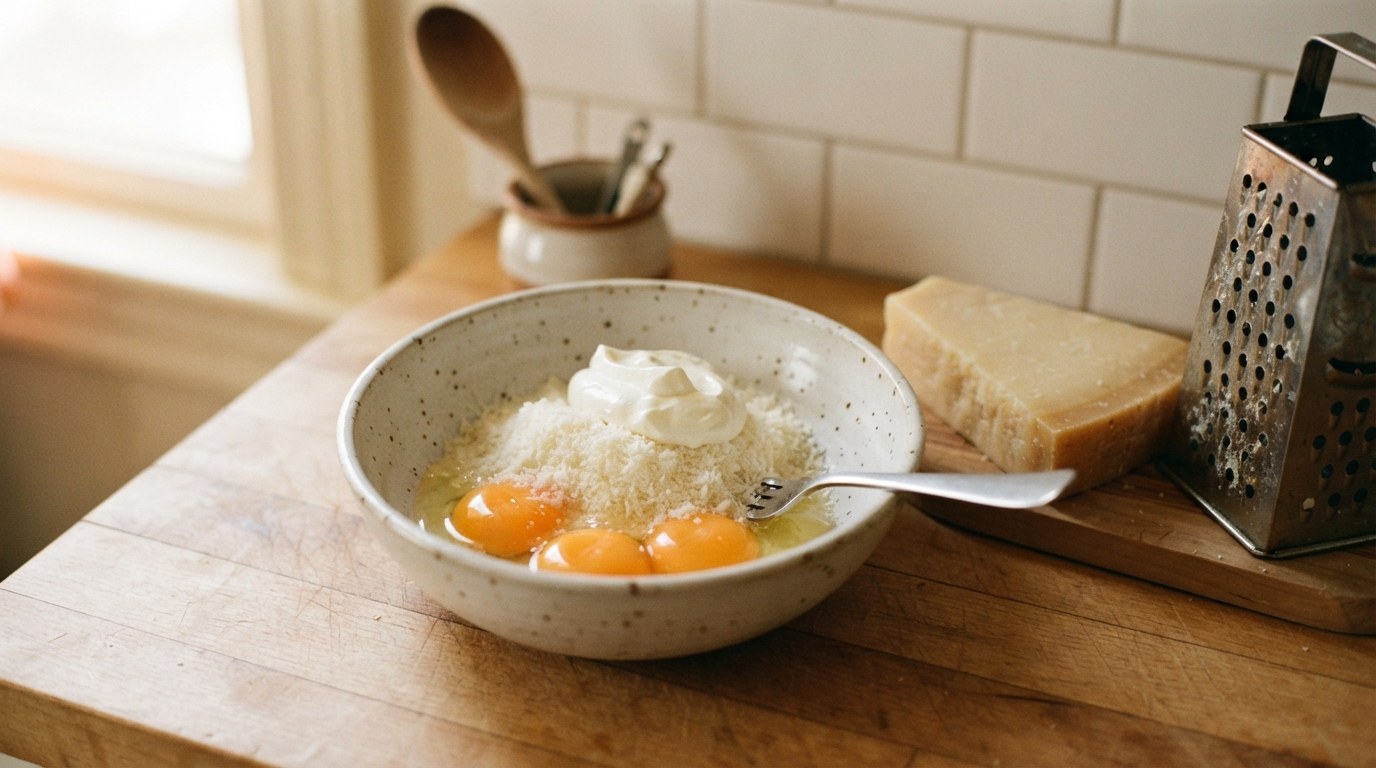
The sauce is yolks, cheese and crème fraîche beaten in a bowl, and understanding its temperature limits is the whole skill of carbonara. Egg yolk proteins begin to thicken at about 149°F and are fully set by 158°F, while egg whites set lower, between 144°F and 149°F, according to Egg Safety Center figures cited by NDSU Extension; spaghetti straight out of boiling water is near 200°F, so neat yolks poured onto it scramble into curds on contact. Two things push the setting point up. Dilution, first: the grated cheese and the crème fraîche spread the yolk proteins out, so they need more heat to link into a solid network, the same reason a custard made with milk and sugar does not set until 174°F to 181°F where a plain egg sets at 140°F. Fat, second: crème fraîche is a cultured cream well above the 25 percent fat at which dairy stops splitting under heat, so it holds the sauce as an emulsion where a splash of milk would curdle. That is the reason Ramsay adds it, and it is why his sauce forgives a few seconds too long on the burner that would break a Roman one.
Ramsay uses yolks only, two per portion, and grates about 40 grams of Grana Padano over them before adding the crème fraîche and a splash of cold water to loosen the mix to a pouring consistency. Yolks rather than whole eggs make a richer, thicker sauce and remove the watery whites that set first and turn stringy. The cheese has to be grated finely from a wedge, because pre-grated cheese is dusted with starch or cellulose to stop it caking and that coating keeps it from dissolving into the yolk. Grana Padano is a hard, aged cow's-milk cheese from the Po valley with protected-origin status, milder and less salty than the Pecorino Romano of the Roman recipe, and its lower salt is worth remembering when seasoning: taste before adding any.
Tossing It Off the Heat: Pasta Water and the Ten-Minute Clock
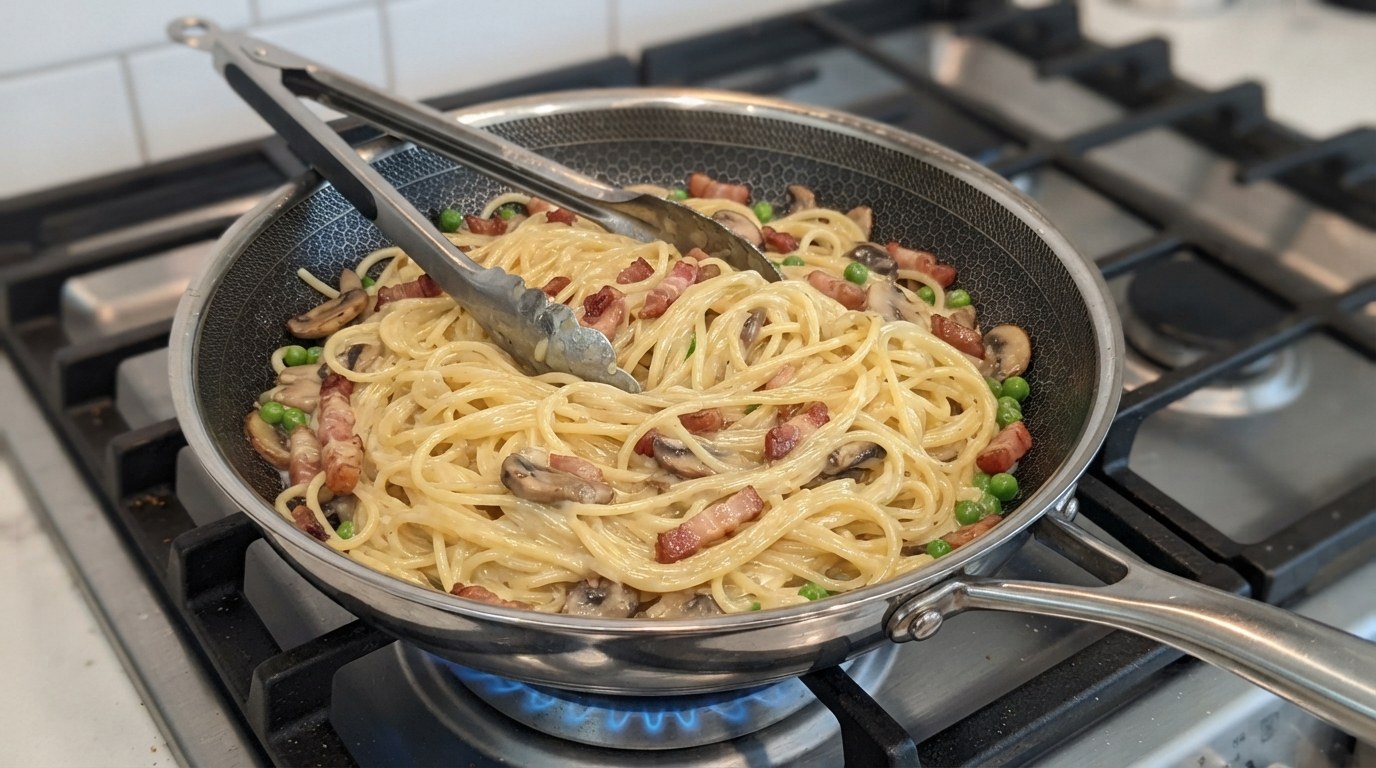
The pasta is dragged straight from the pot into the pancetta pan with some of its water clinging to it, tossed for thirty seconds so the strands take up the fat, and only then does the yolk mixture go in, with the pan on its lowest heat or off it altogether, stirring without stopping until the sauce thickens and clings. Pasta water is the third ingredient in the sauce. It carries starch that gelatinized as the spaghetti cooked, and that swollen starch does two things: it thickens the liquid, and it acts as an emulsifier that holds the rendered pork fat, the melted cheese fat and the crème fraîche in one glossy coating instead of letting them pool as grease. Ramsay stirs about three tablespoons of it into the pancetta pan before the pasta arrives and keeps more back to loosen the finished sauce.
The target is a sauce at roughly 150°F to 160°F, thick enough to coat a strand and the back of a spoon and still liquid enough to run: past 160°F the yolks set into scrambled egg, and below 140°F the cheese fat stiffens and the sauce turns pasty. The pan's residual heat and the pasta's own heat are enough to get there, which is why Ramsay keeps the burner at its lowest and why the stirring never stops; the moving strands spread the heat evenly instead of cooking the egg where it touches the metal. If it looks like it is tightening too fast, a spoon of pasta water brings it back. The peas go in with the pancetta at the end of its cooking, straight from frozen, and warm through in the toss. From the water boiling to the plate is under ten minutes, and the clock is the point of the recipe.
| Stage | Number | What you see |
|---|---|---|
| Pancetta alone | 2 minutes, medium-high, with pepper | Fat rendered and shimmering; edges browning |
| Garlic, then mushrooms and chili | 3 minutes more | Pancetta crisp; mushrooms colored; garlic gold, not brown |
| Peas and pasta water | 3 tbsp water; peas from frozen | Fat loosens into a glossy liquid |
| Pasta into the pan | 30 seconds of tossing | Strands coated in fat |
| Yolk mixture, lowest heat or off | 1 to 2 minutes, stirring constantly | Sauce thickens to coat a spoon at 150°F to 160°F |
| Too far | Above 160°F | Curds of egg; the sauce is scrambled |
The Peas, the Pork, and Eating It Safely
Ramsay puts peas in carbonara because he likes the sweetness and color against the salt of the pork, and because a handful of frozen peas turns a bowl of pasta and bacon into something closer to a meal; that is the honest answer, and he has cooked it that way on television for years knowing exactly what Rome thinks of it. Leave them out and the recipe is unchanged. The pork question has a more practical answer. Guanciale, cured pork jowl, carries more fat than pancetta and renders into a softer, more aromatic base, and it is what the Roman recipe expects; pancetta is cured belly and gives crisper, leaner lardons; smoked streaky bacon, Ramsay's other option, brings smoke that a Roman cook would consider a different dish. Any of the three works in this method, and the pan technique is identical.
The yolks are cooked, not raw, but only gently, and the FDA notes that even clean, uncracked eggs can carry Salmonella and advises cooking eggs until the yolks are firm and egg dishes to 160°F for anyone at higher risk: pregnant, elderly, very young or immunocompromised. A carbonara sauce taken to 155°F is close to that mark but not at it, so for those diners use pasteurized eggs, which are sold in the shell and labeled as treated, and the recipe does not change. Serve the pasta the moment it comes together, in warm bowls with more grated cheese and pepper; carbonara does not hold, since the sauce keeps tightening as it cools, and it does not reheat well either. Leftovers can be brought back the next day in a pan on low heat with a splash of water, stirred until loose, but the texture will be closer to a cheese sauce than to the original.
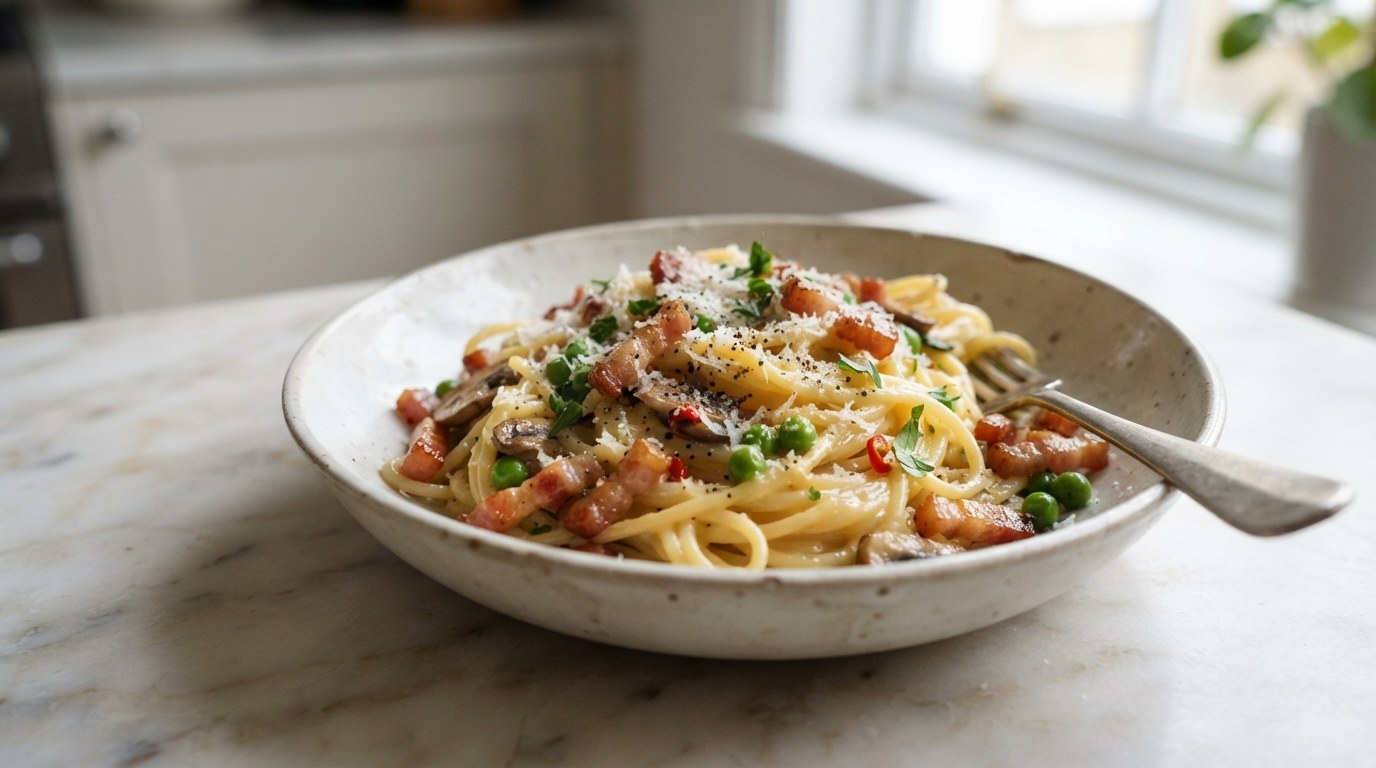
Gordon Ramsay's 10-Minute Carbonara (Pancetta, Peas and Mushrooms)
Ingredients
- 1 lb dried spaghetti
- kosher salt, for the pasta water
- 1 tbsp olive oil
- 11 oz pancetta or streaky bacon, cut into small lardons
- freshly ground black pepper
- 4 garlic cloves, thinly sliced
- 8 oz mushrooms (about 8), sliced
- 1 red chili, minced (2 for more heat)
- 8 egg yolks
- 1⅔ cups finely grated Grana Padano or Parmesan (about 160 g), plus more to serve
- 6 tbsp crème fraîche
- ¾ cup frozen peas
- ¼ cup flat-leaf parsley, chopped
Instructions
- Bring a large pot of well-salted water to a boil and add the spaghetti. Cook until just al dente, about 9 minutes, and reserve a cup of the water before draining.
- While the pasta cooks, heat a large nonstick skillet over medium-high heat, add the olive oil and then the pancetta with a good grind of pepper. Fry for 2 minutes until the fat renders and the edges start to color.
- Add the garlic and cook 1 minute, then the mushrooms and chili. Cook, stirring, until the pancetta is crisp and the mushrooms are browned, about 3 minutes more. Do not let the garlic go past golden.
- Meanwhile, put the yolks in a bowl, grate the cheese over them, add the crème fraîche and 2 to 3 tablespoons of cold water, and beat with a fork to a smooth, pourable mixture.
- Stir the peas into the pancetta pan along with 3 tablespoons of the pasta water and turn the heat to its lowest. Lift the drained spaghetti into the pan and toss for 30 seconds so every strand is coated in the fat.
- Take the pan off the heat or keep it on the lowest setting, pour in the yolk mixture and toss and stir continuously for 1 to 2 minutes until the sauce thickens and clings to the pasta, silky and glossy with no curds. Loosen with more pasta water if it tightens. Fold in the parsley, taste for salt and pepper, and serve at once in warm bowls with more grated cheese.
Notes
Gordon Ramsay Carbonara FAQs
The questions that come up most: why Gordon Ramsay puts peas in carbonara, whether he uses cream, whether to use whole eggs or yolks, why carbonara scrambles, whether the egg is safe, pancetta versus guanciale versus bacon, which cheese to use, and whether carbonara can be reheated.
Why does Gordon Ramsay put peas in carbonara?
For sweetness and color against the salty pork, and to make a pan of pasta and bacon more of a meal. It is his signature addition, not a Roman one; the traditional recipe has no vegetables at all. The peas go in frozen at the end of the pancetta's cooking and warm through in the toss. Leave them out and nothing else changes.
Does Gordon Ramsay use cream in carbonara?
Not cream, but he does add about 1½ tablespoons of crème fraîche per portion to the yolks and cheese. Its job is stability: crème fraîche is high enough in fat to hold an emulsion under heat, so the sauce is less likely to split or scramble. The creaminess itself still comes from the egg yolks and cheese, as in the Roman dish.
Whole eggs or yolks only?
Ramsay uses yolks only, two per portion. Yolks make a richer, thicker sauce and leave out the whites, which set at a lower temperature (144°F to 149°F) and turn stringy. Roman recipes vary, often using whole eggs plus extra yolks. This recipe uses 8 yolks for a pound of spaghetti.
Why did my carbonara scramble?
The egg went past about 158°F, the temperature at which yolk proteins fully set. That happens when the yolk mixture hits pasta straight from boiling water in a pan still over high heat, or when the stirring stops. Take the pan to its lowest heat or off the burner, add the mixture while tossing continuously, and keep pasta water at hand to loosen it.
Is the egg in carbonara raw, and is it safe?
The yolks are cooked by the heat of the pasta to roughly 150°F to 160°F, which thickens them without setting them. The FDA advises cooking egg dishes to 160°F for people at higher risk of Salmonella, so for pregnant, elderly, very young or immunocompromised diners use pasteurized eggs, which are sold in the shell and labeled as treated.
Pancetta, guanciale or bacon?
Guanciale, cured pork jowl, is the Roman choice and the fattiest, rendering into a soft, aromatic base. Pancetta, cured belly, gives crisper, leaner lardons and is what Ramsay lists first. Smoked streaky bacon, his other option, adds smoke a Roman would consider a different dish. All three work in this method without changing the technique.
Which cheese does Gordon Ramsay use for carbonara?
Grana Padano or Parmesan, about 40 grams per portion, grated finely from a wedge. Both are hard, aged cow's-milk cheeses, milder and less salty than the Pecorino Romano of the Roman recipe. Avoid pre-grated cheese: its anti-caking coating stops it dissolving into the yolks.
Can you reheat carbonara?
Not well. The sauce keeps tightening as it cools and turns pasty when reheated, since the cheese fat stiffens and the yolks set further. If you must, warm leftovers in a pan on low heat with a splash of water, stirring until loose. Better to cook only what will be eaten; the whole recipe takes ten minutes.
About the Author
John Siracusa is the founder of Hell’s Kitchen Recipes. He focuses on technique-first, reproducible home cooking and researches recipes & kitchen equipment from published food science and professional chef methods since 2016.