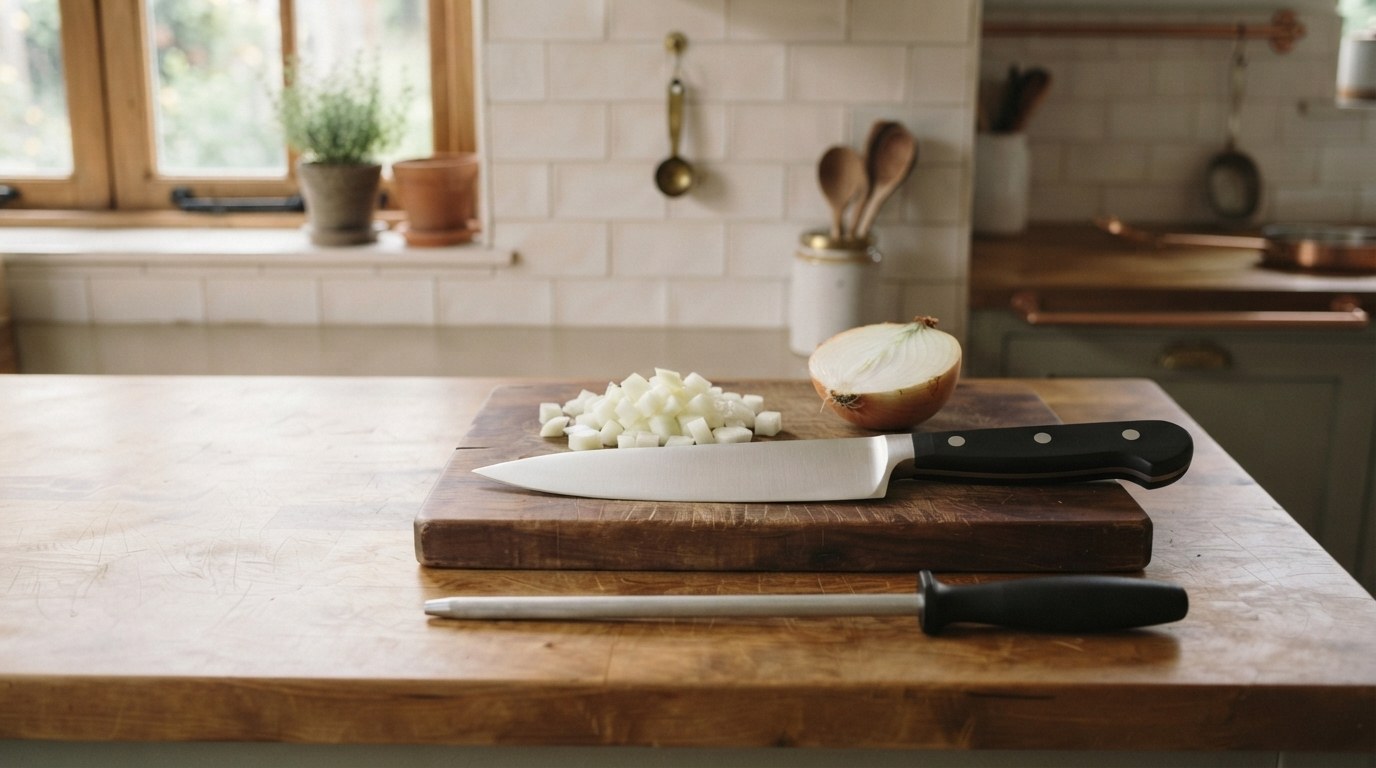
Are Henckels knives good? Yes, but the answer depends on which Henckels you mean, because one company sells two brands under the name. The ZWILLING knives with the twin-figure logo are forged in Germany, hardened to 55 to 58 HRC and among the better German knives you can buy. The HENCKELS value brand with the single-figure logo is a wider range: its forged Classic line, made in Spain to the same hardness band, is very good for the money, while the cheapest stamped lines, made in China and India and rated as low as 50 to 54 HRC, are only fair. So Henckels is a good brand if you buy from the right line.
This page sorts the lines by what actually changes in your hand: where each is made, whether the blade is forged or stamped, how hard the steel is, and what the lifetime warranty covers. If you have already decided on Henckels and want to pick a block, the best Henckels knife sets guide compares the sets themselves. Both pages sit in the site's kitchen gear guides.
Are Henckels Knives Good? The Answer Line by Line
Henckels knives are good from the Classic line up and merely serviceable below it, and the maker's own spec sheets show why. The table lists the 8-inch chef's knife from each main line with the country of origin, build and blade hardness that ZWILLING and Henckels publish for it.
| Line (8-inch chef's) | Logo | Where made | Build | Hardness | Warranty | Verdict |
|---|---|---|---|---|---|---|
| ZWILLING Pro | Twin figures | Germany | Forged from one piece (SIGMAFORGE), ice-hardened | 55-58 HRC | Lifetime, limited | Excellent, a knife for decades |
| ZWILLING Four Star | Twin figures | Solingen, Germany | Forged from one piece, ice-hardened | 55-58 HRC | Lifetime, limited | Excellent, lighter molded handle |
| HENCKELS Classic | Single figure | Spain | Fully forged, bolster | 55-58 HRC | Lifetime, limited | Very good, best value forged |
| HENCKELS Forged Premio | Single figure | China | Forged bolster joined to the blade (listed as welded) | 54 HRC | Lifetime, limited | Good, forged look for less |
| HENCKELS Statement | Single figure | China | Stamped, single piece | 54-56 HRC | Lifetime, limited | Good for a block set |
| HENCKELS Solution / Dynamic | Single figure | India | Stamped, single piece | 50-54 HRC | Lifetime, limited | Fair, a starter knife |
Read the table from the hardness column and the price ladder makes sense. The Henckels Classic shares the ZWILLING Pro's hardness band at a fraction of the price, which is why it is the value pick; the step down from Classic to the Statement and then the Solution is a step down in steel as well as in build, not only a change of factory.
HENCKELS
HENCKELS Classic 8-Inch Chef's Knife
- Fully forged from German stainless steel with a bolster; made in Spain
- Rated 55 to 58 HRC by Henckels, the same hardness band as the ZWILLING Pro
- Triple-rivet handle; dishwasher safe, hand washing recommended; lifetime warranty
The Henckels Classic 8-inch chef's knife is the one to buy if the question is "is a Henckels good enough?" Henckels lists it as fully forged from German stainless steel, made in Spain, at 55 to 58 HRC, dishwasher safe with hand washing recommended, and covered by the lifetime warranty. It behaves like a premium German chef's knife for much less money.
Zwilling vs Henckels: One Company, Two Brands
ZWILLING and HENCKELS are the same company, Zwilling J.A. Henckels, selling a premium brand and a value brand, and the logo tells you which you are holding. According to Zwilling's company history, Peter Henckels registered the ZWILLING name, German for "twin," in the Solingen knife makers' roll on June 13, 1731, and the twin figures are still the premium mark. The HENCKELS brand with the single figure (Henckels calls him the Halberdier) was created by the company in 1895 as its value line; older boxes and many Amazon listings still call it J.A. Henckels International.
That split explains most of the confusion online. A knife reviewed as "Henckels" might be a Solingen-forged ZWILLING Pro or an Indian-made Henckels Solution, two knives that share a company name and almost nothing else. When you shop, look for the logo and the line name, not the word Henckels. The same company makes the knives handed to Hell's Kitchen contestants, and the best Zwilling knives guide compares the premium lines (Pro, Four Star, Professional S and the rest) in detail.
ZWILLING
ZWILLING Pro 8-Inch Chef's Knife
- SIGMAFORGE: forged from a single piece of special-formula high-carbon stainless steel; made in Germany
- FRIODUR ice-hardened blade, 55 to 58 HRC; curved bolster shaped for a pinch grip
- Full tang, triple-rivet handle; lifetime warranty
The ZWILLING Pro 8-inch chef's knife is the premium end of the family: Zwilling lists it as made in Germany, forged from a single piece of special-formula high-carbon stainless steel, FRIODUR ice-hardened to 55 to 58 HRC, with a curved bolster designed for a pinch grip and a lifetime warranty. It costs several times what the Henckels Classic does, and what the extra buys is the one-piece forging, the German manufacture and a bolster shaped for a chef's grip, not harder steel.
Where Are Henckels Knives Made? Germany, Spain, China or India
Henckels knives are made in four countries depending on the line: the ZWILLING Pro and Four Star in Germany (Solingen), the HENCKELS Classic in Spain, the Statement and Forged Premio in China, and the Solution and Dynamic in India, according to the country of origin each maker's product listing gives. So yes, many Henckels knives are made in China, and no, not all of them are German-made.
Two phrases on the box are worth decoding. "German stainless steel" or "German engineered," which Henckels uses on the Spanish Classic and the Chinese Forged Premio, describes the steel and the design, not where the knife was finished. "Made in Solingen" is a legal claim: Germany's Solingen regulation allows the city's name only on cutlery processed and finished in all significant manufacturing stages inside the Solingen industrial area. That is why a ZWILLING Four Star can say Solingen and a Henckels Statement cannot. Wüsthof, the other big Solingen maker, makes the same point in its FAQ; the Wüsthof vs Zwilling guide compares the two.
Country of origin matters less than the spec it comes with. A Spanish-made Henckels Classic is rated in the same hardness band as a German ZWILLING Pro, while the Indian-made Solution sits several points softer; the steel and its heat treatment decide how the edge behaves, and the factory decides the price.
Forged vs Stamped Henckels Knives: What Changes in Your Hand
Forged Henckels knives (ZWILLING Pro and Four Star, Henckels Classic) are heavier with a bolster and better balance; stamped ones (Statement, Solution, Dynamic) are lighter, thinner and cheaper. Forging hammers or presses a heated bar of steel into the knife's shape, which leaves a thick spine and a bolster, the collar of steel where the blade meets the handle. That extra mass moves the balance point forward toward the bolster, where a pinch grip holds the knife, and gives the blade momentum through a rock chop; a squash or a sweet potato splits under the knife's weight instead of your wrist. The bolster also acts as a finger guard.
Stamping cuts the blade from a rolled sheet of steel, so the blade is uniformly thin and there is no bolster. A thin blade wedges less in dense food and is easy to sharpen right to the heel, which a full bolster makes harder over the years. The trade is weight and a less protected grip. The Forged Premio sits between the two: Henckels lists its method as welded, meaning a forged bolster section is joined to the blade rather than the whole knife being forged from one bar.
What forging does not do is make the steel harder. Hardness comes from the alloy and the heat treatment, and the published numbers prove it: the forged Classic and the stamped Statement are only a point or two apart on the Rockwell scale. The santoku vs chef's knife guide covers how blade shape changes the cut, which matters as much as how the blade was made.
Steel and Hardness: Why the HRC Number Matters
A higher HRC number means an edge that holds its shape longer before it needs a steel, and Henckels lines run from 50 to 58 HRC. Every knife edge in use slowly rolls over to one side; harder steel resists that bending, so the edge stays straight longer, while softer steel rolls sooner but is easy to push back with a honing rod. The cost of hardness is brittleness: a very hard edge chips instead of rolling. That is why German knives sit in the mid-50s and Japanese knives go higher; Shun, for example, rates its VG-MAX core at 60 to 61 HRC in its FAQ, and the Shun vs Zwilling comparison walks through what that does in practice.
ZWILLING's FRIODUR step is part of that heat treatment: after the blade is hardened it is cooled well below freezing, which Zwilling says leaves it sharper for longer. The steel itself is stainless because, as the Australian Stainless Steel Development Association explains, it carries at least 10.5% chromium, which forms a thin chromium-rich oxide film on the surface that repairs itself in the presence of oxygen. That film is what keeps a Henckels knife from rusting, and it is the thing to protect when you wash it.
How Long Do Henckels Knives Last?
A forged Henckels or ZWILLING knife that is hand washed, honed and sharpened sensibly lasts decades; Zwilling's own care guide says that with the right care its knives can often last a lifetime. There is no fixed number of years, because knives do not wear out on a timer. They end in one of four ways: years of sharpening grind the blade narrower until it is too slim to be useful, the tip snaps, the handle cracks or loosens, or pitting from neglect eats into the edge.
Build decides how much margin you have against the first of those. A forged blade starts thicker and wider at the heel, so it has more steel to sharpen through, while a softer stamped knife needs sharpening more often and loses metal faster. Honing every few uses realigns the rolled edge without removing steel, and most home cooks only need a true sharpening once or twice a year. The cheapest Solution or Dynamic knife is the one most likely to be replaced rather than worn out, which is what its price is for.
Henckels Warranty: What the Lifetime Warranty Covers
Henckels knives carry a limited lifetime warranty against defects, not against wear. The Henckels warranty says the products will be free of defects in material and workmanship for as long as the original purchaser owns them, applies only to products bought in the United States from Henckels or an authorized U.S. seller, and excludes normal wear and tear, misuse or abuse, alteration, negligence and use other than the intended purpose. If a claim qualifies, Henckels replaces the item, or a comparable one if it is no longer made; it does not repair knives. The same terms apply to ZWILLING, and the Pro and Four Star listings state a lifetime warranty.
In practice that means a handle that splits on its own or a blade with a manufacturing flaw is covered, while a dull edge, a tip snapped by prying, or a knife from an unauthorized marketplace seller is not. Keep the receipt or order confirmation, because the company's claim process asks for proof of purchase, and claims go through its online support center rather than the store.
Are Henckels Knives Dishwasher Safe?
Henckels and ZWILLING knives are rated dishwasher safe, but both makers recommend hand washing, and Zwilling's care guide adds a limit: its special-formula steel is dishwasher-safe only at 55°C (131°F) and lower. Hot wash, sanitize and heated-dry settings can run above that, and Zwilling warns that dishwasher tablets often contain aggressive chemicals, so the rating is better read as "will survive it" than "belongs there."
The reason is the oxide film described above. A dishwasher holds a knife hot and wet for an hour in alkaline detergent, often with salty or acidic food residue, and then leaves it to steam dry in a closed cabinet; that strips and stains the film faster than it can repair, which shows up as spots and, over time, pitting. Knives also knock against other cutlery in the basket and chip their edges. Wash by hand in warm water with a little dish soap, dry straight away with a towel, and the steel stays bright.
Henckels Knife Care: Hone, Sharpen and Store
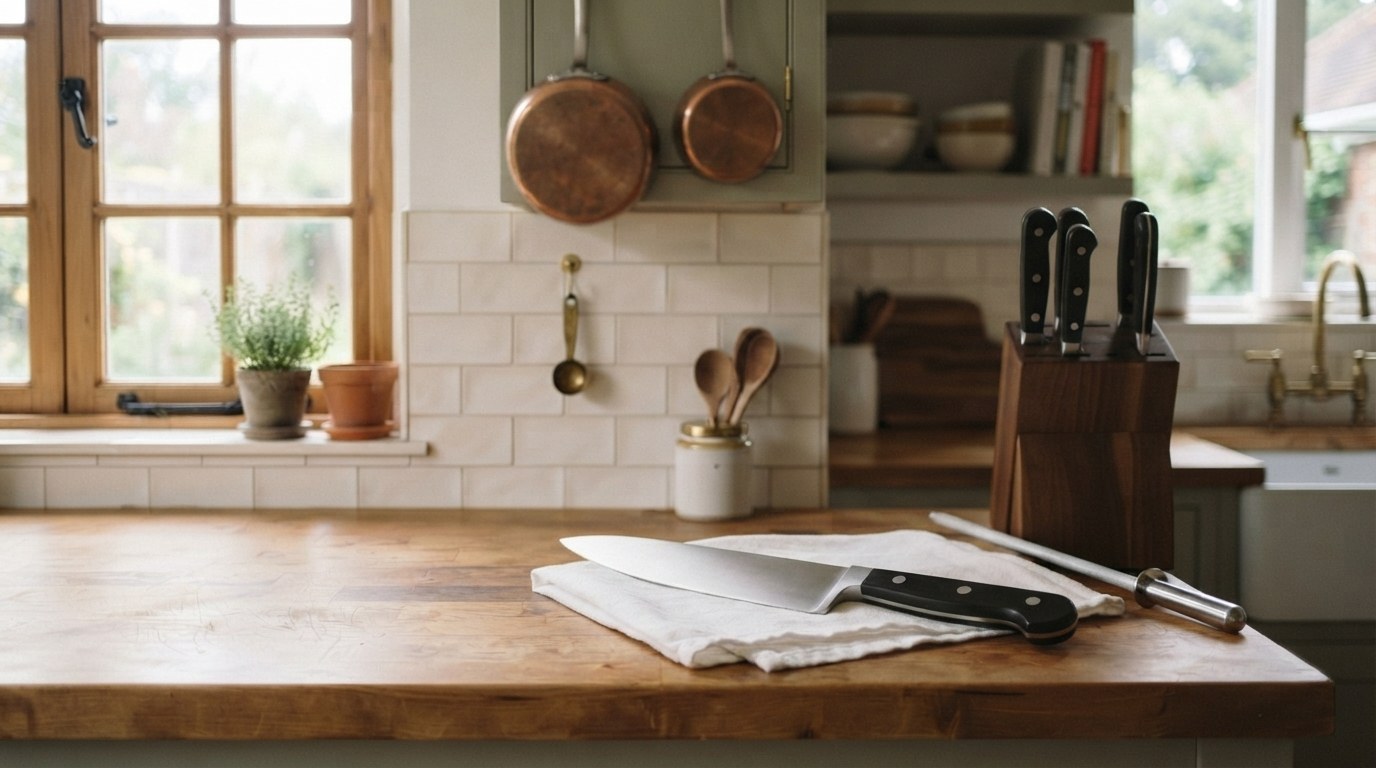
Henckels knives keep their edge longest when you hone them often, sharpen them rarely and store them apart from other metal. Run the straight-edged knives along a honing steel every few uses to push the rolled edge back into line, and sharpen on a whetstone or a pull-through once honing stops bringing the bite back. Leave serrated bread and steak knives alone; their teeth do the cutting. Cut on wood or plastic boards, never on glass, stone or a ceramic plate, which flatten an edge in a few strokes.
For storage, Zwilling's care guide calls a knife block the preferable choice, with drawer inserts or blade guards as alternatives; a loose knife in a drawer full of utensils chips its edge and its tip. Treat wooden handles the same way you treat the blade: no soaking. That routine, plus a gentle hand, is the whole difference between a Henckels knife that lasts five years and one that lasts thirty.
So, Is Henckels a Good Brand?
Henckels is a good brand when you buy the right line. Choose ZWILLING Pro or Four Star for a German-made forged knife that will outlast your kitchen, the Henckels Classic for the best forged value, and the Statement block when you want a full set of light knives. Skip the Solution and Dynamic lines unless the budget is tight, because they are the softest steel in the family. If you are choosing a set rather than one knife, the best Henckels knife sets guide picks the block, and the best German knife brands roundup puts Henckels next to Wüsthof and the rest. Are Henckels knives good? The forged ones are very good, and the cheapest stamped ones are fine for a first kitchen.
Henckels Knives FAQs
The questions that come up most: whether Henckels knives are good, where they are made and whether any come from China, how Zwilling and Henckels differ, forged or stamped, dishwasher safety, the lifetime warranty, how long they last, and how they compare to Wüsthof.
Are Henckels knives good?
Yes, from the Classic line up. The ZWILLING Pro and Four Star are forged in Germany at 55 to 58 HRC and rank with the best German knives, and the Henckels Classic is forged in Spain to the same hardness band for much less money. The stamped Statement is good for a block set, while the Solution and Dynamic lines, rated 50 to 54 HRC, are only fair.
Are Henckels knives made in China?
Some are. Henckels lists the Statement and Forged Premio lines as made in China and the Solution and Dynamic lines as made in India, while the Classic is made in Spain and the premium ZWILLING Pro and Four Star are made in Germany. "German stainless steel" on the box describes the steel, not where the knife was finished.
Is Zwilling the same as Henckels?
They are the same company, Zwilling J.A. Henckels, but two brands. ZWILLING, with the twin-figure logo, is the premium line forged in Germany; HENCKELS, with the single-figure logo and once sold as J.A. Henckels International, is the value brand created in 1895 and made in Spain, China and India depending on the line.
Are Henckels knives forged or stamped?
Both. The ZWILLING Pro and Four Star and the Henckels Classic are forged, with a bolster and forward balance; the Statement, Solution and Dynamic lines are stamped from sheet steel and lighter. The Forged Premio has a forged bolster joined to the blade, which Henckels lists as welded.
Are Henckels knives dishwasher safe?
They are rated dishwasher safe, but Henckels and Zwilling both recommend hand washing, and Zwilling says its steel is dishwasher-safe only at 55°C (131°F) or lower. Hot, wet, alkaline cycles stain the chromium oxide film that keeps stainless steel from rusting, and knives chip against other cutlery, so wash by hand and dry at once.
Do Henckels knives have a lifetime warranty?
Yes, a limited one. Henckels warrants its products against defects in material and workmanship for as long as the original purchaser owns them, for products bought in the U.S. from an authorized seller. It does not cover normal wear and tear, misuse, abuse or negligence, and it replaces rather than repairs the knife.
How long do Henckels knives last?
A forged Henckels or ZWILLING knife that is hand washed, honed and sharpened sensibly lasts decades, and Zwilling says its knives can often last a lifetime with the right care. A knife usually ends when years of sharpening have narrowed the blade, the tip breaks, the handle cracks, or neglect pits the steel.
Are Henckels knives better than Wüsthof?
ZWILLING knives are on a level with Wüsthof: both are forged in Solingen, Germany at similar hardness, and the choice comes down to handle shape and balance. The value HENCKELS lines are a step below Wüsthof and priced accordingly; the Wüsthof vs Zwilling guide compares the premium knives directly.

About the Author
John Siracusa is the founder of Hell’s Kitchen Recipes. He focuses on technique-first, reproducible home cooking and researches recipes & kitchen equipment from published food science and professional chef methods since 2016.