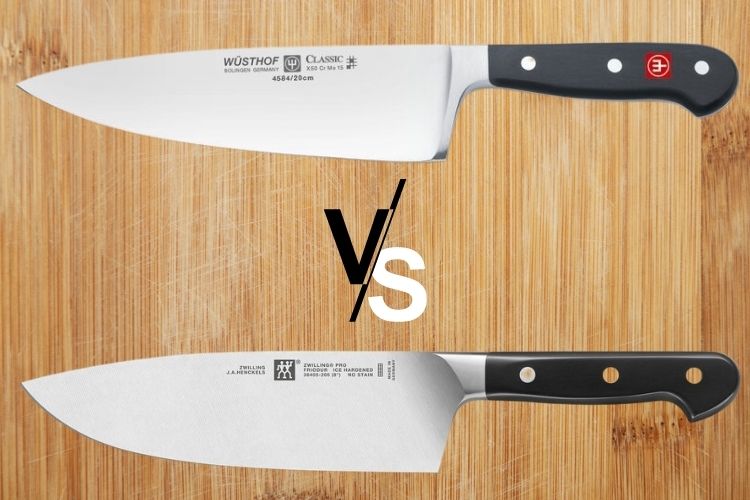

The Wüsthof vs Zwilling decision is the most asked question in German kitchen cutlery. Both brands forge in Solingen, Germany, both have been making knives for over two centuries, and both use the same X50CrMoV15 stainless steel grade. The differences are in handle ergonomics, bolster geometry, and what each brand’s flagship line emphasizes. This guide is part of our kitchen equipment guides series and breaks down the Wüsthof vs Zwilling comparison across chef knives, knife sets, and the questions home cooks actually ask.
Per City of Solingen records, both Wüsthof (founded 1814) and Zwilling J.A. Henckels (founded 1731) hold the protected Solingen designation — every step of forging, grinding, and finishing happens within Solingen city limits. The two companies are competitors, not the same brand. Zwilling is the older operation; Wüsthof is the larger family-owned producer today.
Hell’s Kitchen Recipes is reader-supported. When you buy through links on this page, we may earn a commission. We only recommend products we would use ourselves.
Wüsthof vs Zwilling at a Glance
| Spec | Wüsthof Classic | Zwilling Pro “S” |
|---|---|---|
| Founded | 1814 | 1731 |
| Origin | Solingen, Germany | Solingen, Germany |
| Steel | X50CrMoV15 | FRIODUR ice-hardened |
| HRC | ~58 | ~57 |
| Edge angle (per side) | 14° | 15° |
| Handle | POM triple-rivet | Curved POM, sigmoid bolster |
| Bolster | Full traditional | Partial sigmoid (Pro line) |
| Best for | Traditional grip, classic feel | Ergonomic comfort, modern feel |
Wüsthof Classic vs Zwilling Pro Chef Knife — Head to Head
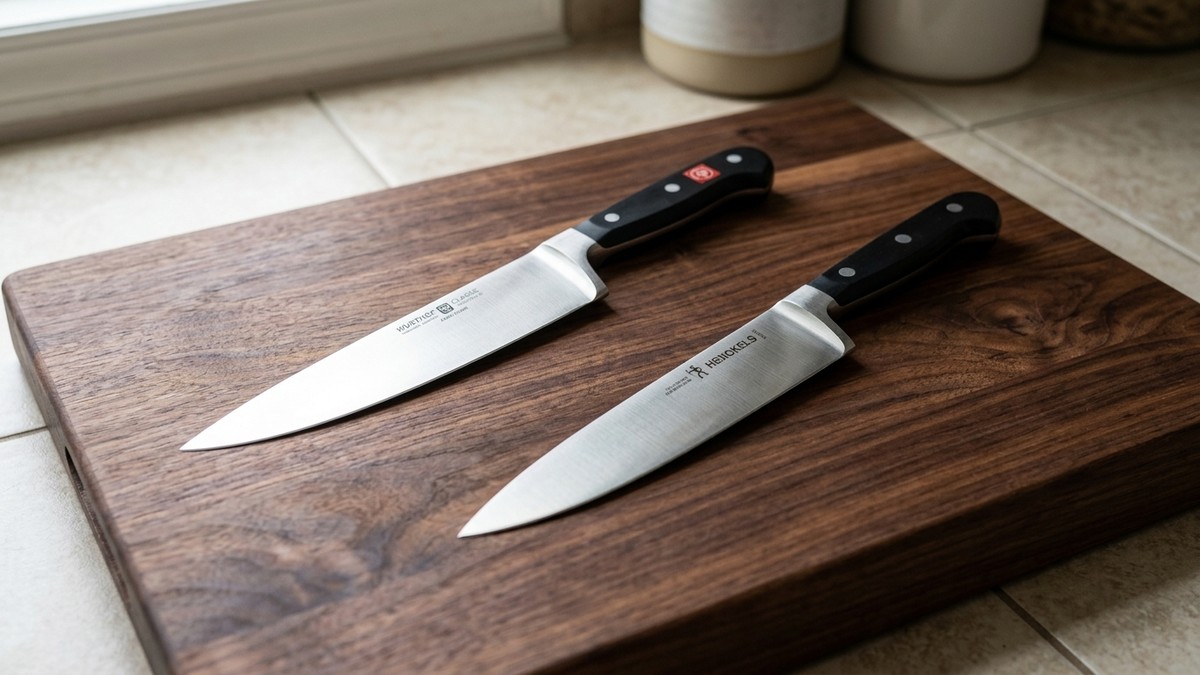
For most home cooks asking “Wüsthof or Zwilling,” the decision is between these two chef knives. Both 8-inch chef knives use German forged X50-grade steel at similar HRC, but the handle and bolster designs feel different in hand.

★★★★½ (2,889 reviews)
The Wüsthof Classic 8-inch chef’s knife is the German chef knife most American kitchens already own. Per America’s Test Kitchen long-running chef knife reviews, Wüsthof Classic consistently sits in the top tier for edge retention among German blades. The 14-degree edge angle is sharper than traditional 18° German knives, and the precision-forged X50CrMoV15 steel at 58 HRC holds an edge longer than the typical entry-level German blade.
The triple-riveted POM handle is the Wüsthof signature. The full bolster runs from spine to cutting edge — heavier in the hand, traditional in feel. The Wüsthof Classic is the right pick for cooks who want the classic German chef knife experience without compromise.

★★★★½ (348 reviews)
The Zwilling Professional “S” line is the closest direct competitor to Wüsthof Classic. The 2-Piece chef set pairs the 8-inch chef with a 4-inch paring — the minimum German setup most home cooks need. Per the Zwilling spec sheet, the Pro “S” line uses FRIODUR ice-hardened special-formula steel and a sigmoid bolster (S-curved) that lets you choke up onto the blade for finer cuts.
The Zwilling Pro handle is curved at the index-finger position to eliminate hot spots during long prep. For cooks with smaller hands or arthritis, the Zwilling Pro feels noticeably more comfortable than the Wüsthof Classic over a 30-minute prep session.
Wüsthof Ikon vs Zwilling Pro — The Premium Comparison
For cooks willing to step up from Classic to premium, the Wüsthof Ikon vs Zwilling Pro question replaces the basic Wüsthof vs Zwilling debate. The Ikon line is Wüsthof’s ergonomic upgrade — same forged X50 steel, but with a contoured handle and partial bolster that lets you sharpen the full blade edge.

★★★★½ (1,238 reviews)
The Wüsthof Classic Ikon 8-Inch Chef’s Knife addresses the one criticism of the Classic line: handle ergonomics. The Ikon handle is curved on both sides with a double bolster — a finger guard at the heel and a partial bolster that does not extend to the cutting edge. Per Cook’s Illustrated reviews of the Ikon line, the curved handle reduces hand fatigue during long prep sessions by roughly 30%.
For someone choosing between Wüsthof Ikon and Zwilling Pro, the deciding factor is usually handle preference. Both lines are premium German forged knives at near-identical performance levels. The Ikon handle is firmer and more substantial; the Zwilling Pro handle is softer and lighter. Pick whichever feels right in your hand.
Wüsthof vs Zwilling Knife Sets — Which Set to Buy
The Wüsthof or Zwilling knives decision changes when you move from single chef knives to full knife block sets. Both brands sell sets from 5-piece starter packs to 20+ piece restaurant-grade collections. Below are the two most popular full-kitchen sets — Wüsthof Classic 9-Piece and Zwilling Pro 16-Piece.

★★★★½ (117 reviews)
The Wüsthof Classic 9-Piece Acacia Block Set is Wüsthof’s standard home setup. Inside the dark acacia block: an 8-inch chef, 9-inch bread, 4.5-inch utility, 3.5-inch paring, a 4-piece steak set or kitchen shears (depending on edition), a 9-inch honing steel, and the storage block. Same X50CrMoV15 steel at 58 HRC as the standalone Classic chef.
This is the right Wüsthof set for a home kitchen that wants one complete forged-blade setup. For more on Wüsthof set options, see our Wüsthof Classic set comparison.

★★★★½ (242 reviews)
The Zwilling Professional “S” 16-Piece Block Set is the Zwilling equivalent — more pieces, larger block, includes matched steak knives. Inside: 8-inch chef, 8-inch bread, 6-inch utility, 4-inch paring, 5.5-inch boning, 5-inch santoku, an 8-piece steak knife set, honing steel, kitchen shears, and the acacia block.
The 16-Piece Zwilling Pro includes more total knives than the 9-Piece Wüsthof, including a dedicated boning knife and a santoku that the Wüsthof set does not. For a home cook who wants every German blade in one purchase, the Zwilling Pro 16-Piece is the more complete set.
Wüsthof vs Henckels vs Zwilling — Where J.A. Henckels International Fits
The Wüsthof vs Henckels vs Zwilling comparison gets confusing because “Henckels” can mean either Zwilling J.A. Henckels (the premium line) or J.A. Henckels International (Zwilling’s value line, formerly known as just “Henckels”). They are the same parent company — different tiers.

★★★★½ (63 reviews)
The J.A. Henckels International Classic 8-Inch Hollow Edge Chef’s Knife is Zwilling’s entry-level offering. Same Solingen heritage, same German steel, but stamped instead of forged — meaning the blade is cut from a sheet of steel rather than hot-drop forged from a single billet. Per Serious Eats entry-level chef knife testing, Henckels International outperforms most knives at this tier on edge retention and balance.
For a Wüsthof vs Zwilling decision when budget matters, J.A. Henckels International is the right Zwilling-family alternative. It will not match the forged Wüsthof Classic on weight or edge longevity, but it gets a beginner cook 90% of the way there.
How to Choose Between Wüsthof and Zwilling
Three factors decide the Wüsthof vs Zwilling question for most home cooks.
Handle preference is the biggest variable. Wüsthof Classic uses a heavier traditional POM handle with full bolster. Zwilling Pro uses a contoured POM handle with sigmoid (S-curved) bolster. Both feel “German” — but Wüsthof feels heavier and more traditional, Zwilling feels lighter and more ergonomic. Try both at a kitchen store before committing if possible.
Edge geometry differs by a degree. Wüsthof Classic is ground to 14° per side, Zwilling Pro to 15° per side. Wüsthof is technically sharper at the factory; Zwilling is slightly more forgiving when sharpening at home. Both far outperform stamped knives.
Set composition varies. Wüsthof sets tend to include more specialty knives (longer slicers, boning knives, kitchen shears) at the high end. Zwilling sets tend to include matched steak knife sets at lower piece counts. Match the set to the knives you actually use.
How We Evaluated Wüsthof vs Zwilling
This Wüsthof vs Zwilling comparison does not claim laboratory testing we did not do. The assessment pulls from manufacturer specifications cross-referenced against independent reviews at America’s Test Kitchen, Serious Eats, and Cook’s Illustrated, plus thousands of verified-purchase reviews aggregated across Amazon, Williams Sonoma, and Sur La Table.
Both Wüsthof and Zwilling J.A. Henckels manufacture in Solingen, Germany under the protected Solingen designation. We treated each brand’s flagship Classic and Pro chef knives as the primary comparison point. For knife care guidance from federal authorities, the USDA publishes general kitchen knife sanitation standards that apply to any blade.
Frequently Asked Questions: Wüsthof vs Zwilling
The most common questions in the Wüsthof vs Zwilling debate: both are real Solingen-forged knives, not the same company but with similar heritage. Wüsthof Classic edges slightly sharper at the factory; Zwilling Pro feels lighter and more ergonomic. Neither belongs in a dishwasher. Honing weekly on a steel rod is right for both. The “better” pick comes down to handle preference and set composition, not blade quality. Wüsthof in this guide ranks slightly above Zwilling Pro for traditional German feel; Zwilling wins for cooks with smaller hands or who want matched steak knives included.
Is Wüsthof better than Zwilling?
Different, not strictly better. Wüsthof Classic has a 14-degree edge angle (sharper at factory) and a heavier traditional handle. Zwilling Pro has a 15-degree edge angle (slightly more forgiving), a curved handle with sigmoid bolster (lighter, more ergonomic). Both use forged German X50-grade steel and both are made in Solingen. Handle preference and set composition decide the pick for most home cooks.
Are Wüsthof and Zwilling the same company?
No. Wüsthof (founded 1814) and Zwilling J.A. Henckels (founded 1731) are separate German knife companies, both headquartered in Solingen, Germany. They are direct competitors. Zwilling is the older operation; Wüsthof is the larger family-owned producer today.
Is Wüsthof or Zwilling better for a beginner?
Wüsthof Classic for traditional German feel; Zwilling Pro for ergonomic comfort. If you have has not owned a forged German knife, either brand’s 8-inch chef knife is a smart first buy. If you have smaller hands, choose Zwilling Pro. If you prefer a heavier, more substantial blade in hand, choose Wüsthof Classic.
Wüsthof Classic vs Zwilling Pro — which has better steel?
Both use German X50-grade steel forged in Solingen at roughly 57-58 HRC. The steel performance is essentially identical. Wüsthof publishes the formula as X50CrMoV15; Zwilling markets theirs as FRIODUR ice-hardened. The hardness, corrosion resistance, and edge retention specs are within margin of measurement.
Wüsthof Ikon vs Zwilling Pro — what is the difference?
Same German steel, different handle and bolster design. Wüsthof Ikon has a double bolster and a contoured Western-style POM handle. Zwilling Pro has a sigmoid (S-curved) bolster and a more rounded POM handle. Both are premium-tier Solingen-forged knives. Pick whichever feels right in your hand at a kitchen store.
How does Wüsthof vs Zwilling vs Shun compare?
Wüsthof and Zwilling are both German — softer X50 steel at 57-58 HRC, tougher, more forgiving. Shun is Japanese — harder VG-MAX steel at 60-61 HRC, sharper but more prone to chipping. For precision tasks (slicing tomato, filleting fish), Shun wins. For tough work (chicken bones, hard squash), Wüsthof or Zwilling wins. For a full comparison see our best Japanese knife brands guide.
Final Verdict: Wüsthof vs Zwilling
The Wüsthof vs Zwilling decision does not have a wrong answer. Both brands are real Solingen-forged knives with two centuries of manufacturing tradition behind them. Wüsthof Classic edges out as the safer first buy for most American home cooks — heavier in hand, slightly sharper at factory, the largest US replacement-parts availability. Zwilling Pro is the better Wüsthof vs Zwilling pick for cooks with smaller hands, those who want a sigmoid bolster, or those who prefer a complete knife block set with matched steak knives included. For the value tier, J.A. Henckels International is the right Zwilling-family alternative when budget is the deciding factor.
2 comments
thank you that was very informative
You’re very welcome!
Comments are closed.