Detroit-style pizza is the square, deep-sided pan pizza with a light, open crumb, cheese pushed all the way to the pan walls so it fries into a dark, lacy crust, and the tomato sauce spooned on top in stripes after the bake. It looks like a project. It is not. The dough is a wet, no-knead bread dough that does its own work while you get on with the sauce, and the pan does the rest.
This guide covers what the card cannot: why the dough is that wet, why the cheese goes on before the sauce, what makes the edges crisp, and what to do if you do not own a Detroit pan.
What Makes Detroit-Style Pizza Different
Three things separate Detroit-style pizza from every other pan pizza: a rectangular steel pan with tall sides, a mild, high-fat cheese (Wisconsin brick) spread edge to edge, and sauce that goes on after baking rather than under the cheese. The style started at Buddy's Rendezvous on Detroit's east side in 1946, where the first pies were baked in blue-steel pans borrowed from the city's auto plants, according to Buddy's Pizza. Those pans conduct heat fast and hold it, which is why the bottom fries rather than steams.
It is not deep dish. Chicago deep dish is a pastry-like crust filled with cheese and topped with a thick layer of sauce; Detroit-style pizza is bread, closer to focaccia, and the crumb should be airy enough to see daylight through a slice. It is also not simply Sicilian, though it grew out of that tradition. The Institute of Culinary Education traces the square shape and the cheese-to-the-edge habit back to those automotive pans; the crisp cheese wall is the tell. If your slice has a soft cheese border, it is a Sicilian.
A 75% Hydration Dough Is the Whole Secret
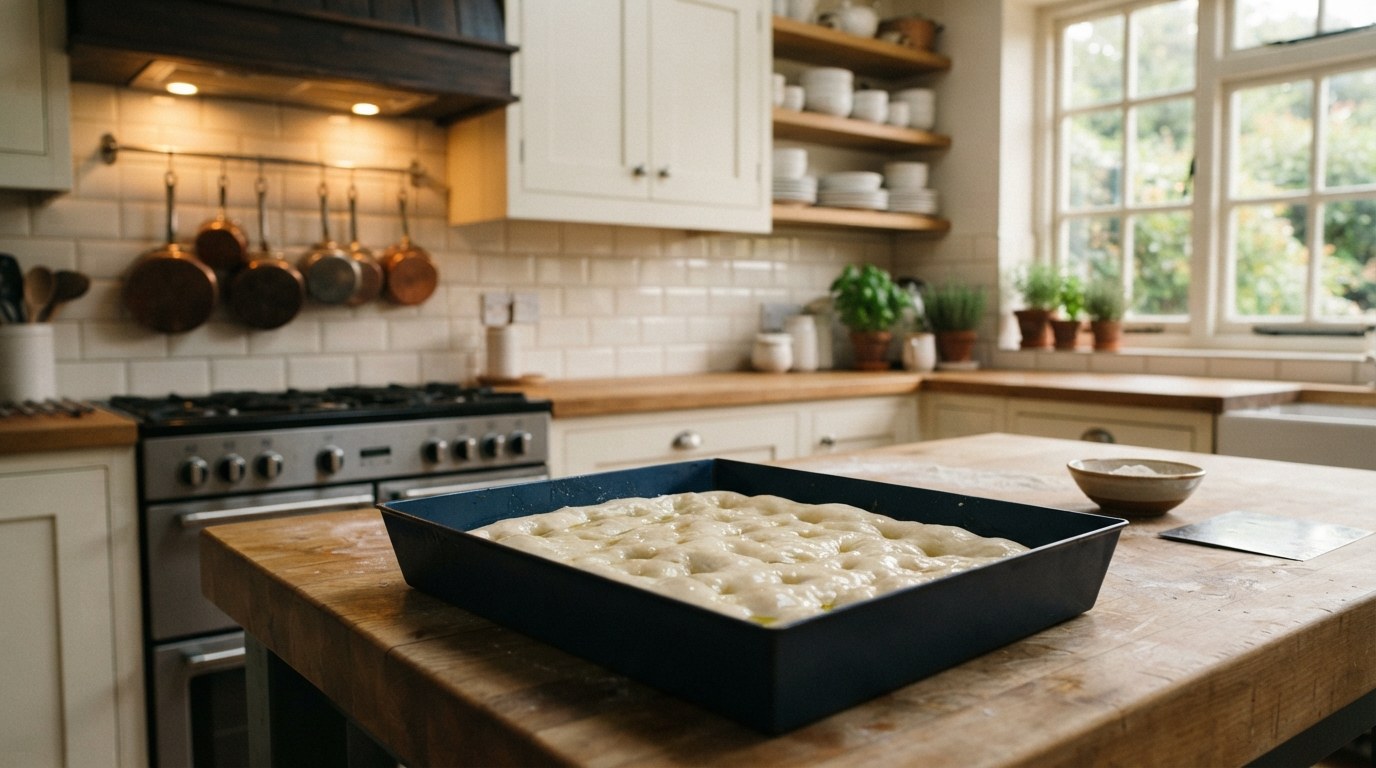
The dough in this recipe is 75% hydration, meaning 75 grams of water for every 100 grams of flour, and that number is what gives Detroit-style pizza its open, tender crumb. Wetter dough traps more steam as it bakes, so the holes get bigger and the walls between them get thinner. It is also why you will not knead it. Gluten forms when the two wheat proteins, gliadin and glutenin, hydrate and link into a stretchy network, and a wetter dough builds that network with far less mechanical work, as a 2022 study in Foods on dough hydration and mixing found. A few folds in the bowl and a long rise do the job a stand mixer would.
Use bread flour, not all-purpose. Bread flour runs around 12.5 to 13.5 percent protein (Bob's Red Mill lists its artisan bread flour at 12.7 percent), and that extra protein is what lets a dough this wet hold its shape and climb the pan walls instead of slumping. The dough will feel sticky and tacky, like the back of a Post-it, and that is correct. Gordon Ramsay's rule for pasta dough applies here too: flour your hands, not the dough. Salt goes in with the flour, because the crust is the one part of this pizza you cannot season later.
Two temperatures matter. Keep the water around 105°F to 110°F; yeast dies at 140°F, and water that feels hot on your wrist is already too hot. And let the dough double at room temperature, roughly 90 minutes to 2 hours, before it goes in the pan. A cold kitchen simply takes longer. Do not rush it with a warm oven.
Brick Cheese to the Edges Makes the Crispy Crust
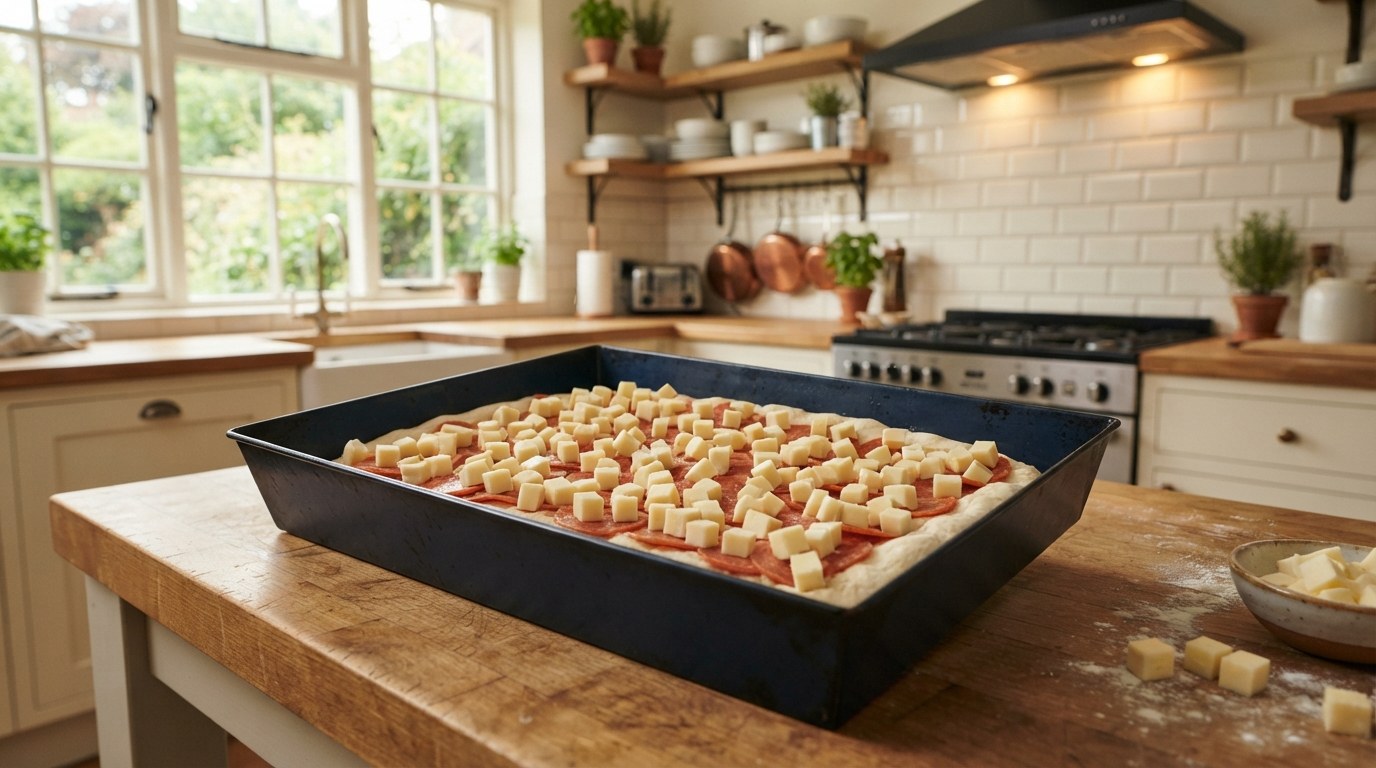
The signature dark, lacy edge on Detroit-style pizza is cheese, not crust, and it happens because the cheese touches hot steel. Where cheese meets the pan wall, its water boils off, its fat renders, and the milk proteins and sugars left behind brown in the Maillard reaction, which starts at about 284°F. That cannot happen in the middle of the pizza, where the cheese sits on wet dough and never gets above the boiling point of water. It only happens at the edge, so put cheese there on purpose, piled right up against the walls.
Wisconsin brick cheese is the traditional choice because it is mild, high in fat, and melts without going stringy or greasy. It was first made in Wisconsin in the 1870s and takes its name from the actual bricks cheesemakers used to press the curd, per Wisconsin Cheese; the young version is the one you want, and Widmer's Cheese Cellars still presses it the old way. If you cannot find it, use a mix of low-moisture mozzarella and Monterey Jack in the same weight. The Jack supplies the fat that mozzarella alone lacks, and fat is what fries the edge. Cut the cheese into small cubes rather than shredding it; cubes melt into pools and brown at the wall, while shreds dry out and toughen.
Half the pepperoni goes under the cheese and half on top. The buried layer seasons the cheese from underneath; the top layer curls into cups and crisps. Use small, natural-casing pepperoni if you can get it, because it cups more reliably.
Why the Sauce Goes On Top
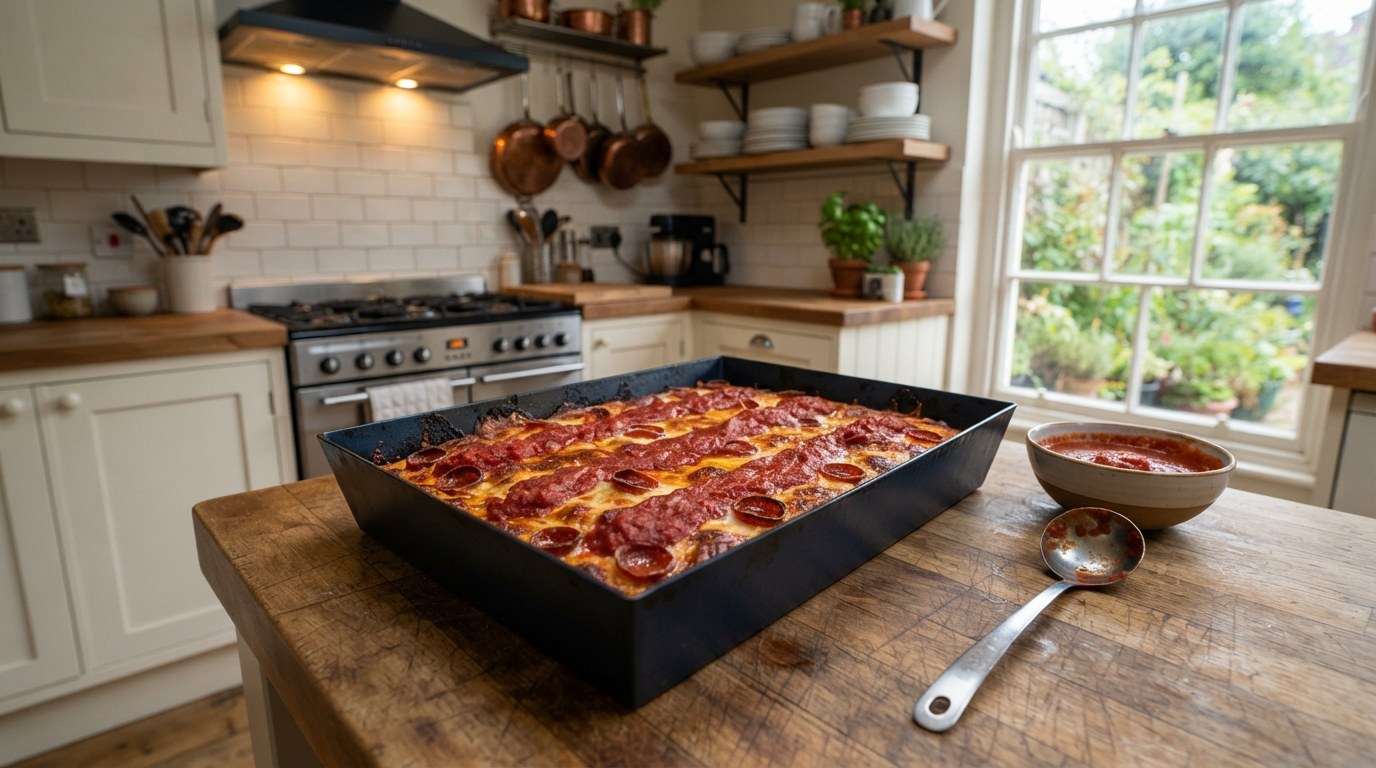
Sauce goes on after the bake for a practical reason: water is the enemy of browning. Nothing browns until its surface dries out, because water cannot get hotter than 212°F, and a layer of wet sauce under the cheese keeps the whole top of the pizza steaming instead of browning. Put the sauce on last, in two or three stripes, and the cheese below stays dry enough to blister and the crust below that stays crisp. The stripes are tradition, but they are also portion control; a full flood of sauce would soften the top within minutes.
The sauce itself is simple and cooked down on purpose. Simmer crushed tomatoes with garlic, dried oregano, and olive oil until they reduce to about a cup and a quarter, so what lands on the pizza is thick and concentrated rather than watery. It keeps in the refrigerator for three days, so make it while the dough rises and do not throw the extra away.
How to Bake It: 500°F, Lowest Rack
Bake Detroit-style pizza at 500°F on the lowest oven rack for 14 to 18 minutes, until the cheese at the edges is deep brown and the bottom is crisp. The low rack is deliberate: it puts the pan closest to the heating element so the bottom fries in the oil before the top dries out. If you own a baking steel or stone, preheat it on that rack and set the pan directly on it; the extra stored heat gets the bottom crisp faster. Give the oven a full 30 minutes to preheat. The pan needs to hit a hot surface, not a warm one.
The crust is done when the crumb inside reaches about 200°F, but you will not need a thermometer. Look at the edges: deep brown cheese, pulling slightly away from the wall, is the sign. Rest the pizza in the pan for 5 minutes, then run a thin metal spatula around the sides and lift it onto a board. Cutting it in the pan scratches the seasoning. Resting does not "relax" anything; it lets the cheese set enough to slice cleanly.
Two more Ramsay habits carry this recipe. First, get organized before the oven goes on: sauce made, cheese cubed, pepperoni ready. Once the pizza is topped it should go straight in, because a topped dough left waiting loses lift. Second, cook with your eyes. Ovens run hot and cold, so trust the color of the edge over the clock.
No Detroit Pan? Use a 9x13 or a Cast-Iron Skillet
You do not need a dedicated pan to make Detroit-style pizza. A 10-by-14-inch anodized or blue-steel pan from a maker like Lloyd Pans gives the classic tall, straight edge, but a 9-by-13-inch metal baking pan works with the same dough, and a 12-inch cast-iron skillet makes a round version with an equally good fried edge. Avoid glass: it heats slowly and the bottom stays pale. Whatever the pan, coat it generously with olive oil. That oil is what fries the bottom crust; skimp on it and you get bread, not pizza.
Two more sizing notes. In a 9-by-13 pan the dough sits a little thinner, so start checking at 12 minutes. In a cast-iron skillet, preheat the empty skillet for 10 minutes before the dough goes in if you want the bottom extra crisp, but work fast, because the dough starts cooking on contact.
Storing and Reheating Detroit-Style Pizza
Detroit-style pizza reheats better than most, because the crust is bread and bread comes back with dry heat. Reheat squares in a 400°F oven or an air fryer for 5 to 7 minutes, or in a dry skillet over medium heat with a lid for the last minute to melt the cheese. Do not use the microwave: the starch in bread recrystallizes as it cools (the same process that stales a loaf), and microwaving steams it soft for a moment before it turns tough. Dry heat re-crisps it instead.
Store leftovers wrapped in the refrigerator for up to 3 days. The dough can be made a day ahead too: let it rise, punch it down, and refrigerate it covered for up to 12 hours, then bring it to room temperature in the pan before the second rise. For more bread-based cooking, try Ramsay's rosemary garlic dinner rolls, and browse the rest of the recipes collection. If you are choosing a pan, the kitchen gear guides cover cast iron and steel.
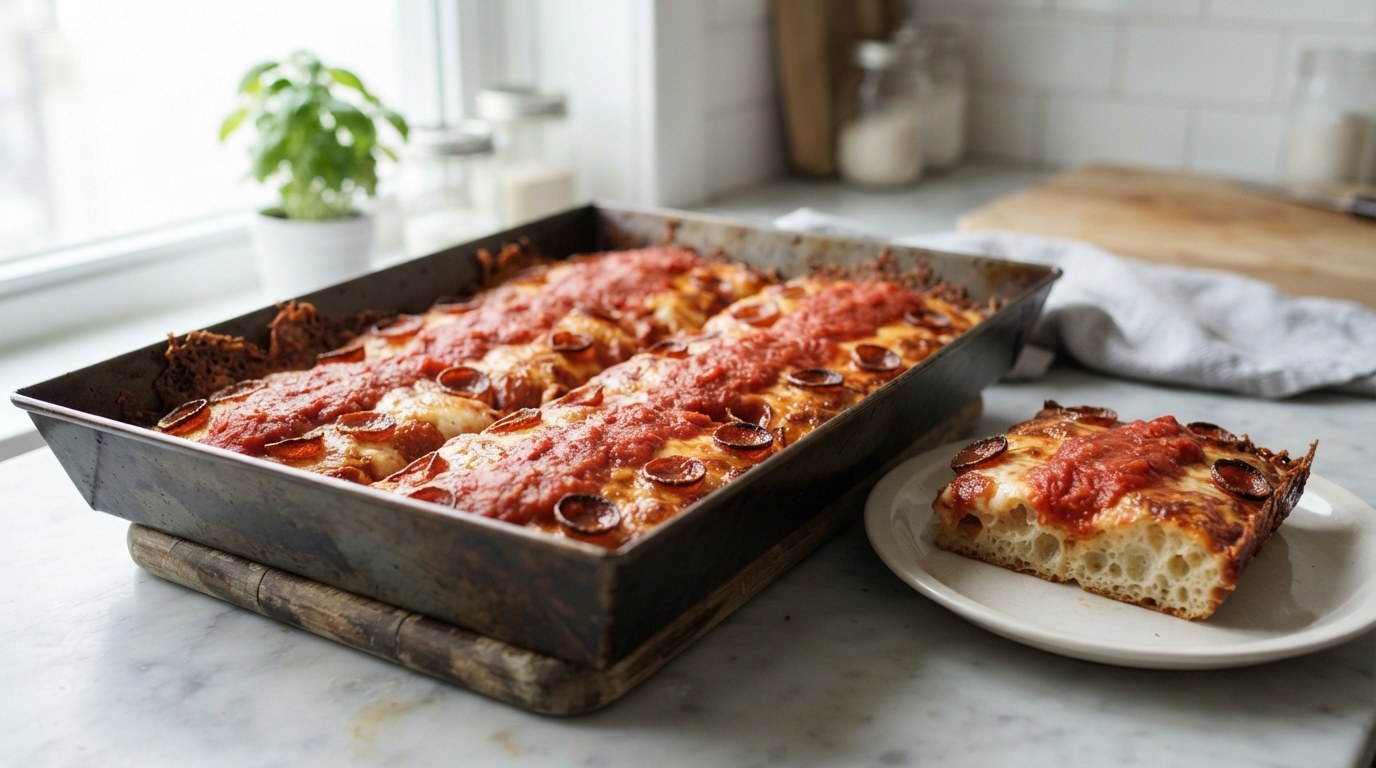
Detroit-Style Pizza
Ingredients
- 2 2/3 cups bread flour (320 g)
- 1 cup warm water, 105°F to 110°F (240 g)
- 1 tsp instant yeast
- 1 1/4 tsp fine salt
- 3 Tbsp extra-virgin olive oil, for the pan
- 4 oz pepperoni, thinly sliced, divided
- 8 oz Wisconsin brick cheese, cut into 1/2-inch cubes (or 4 oz low-moisture mozzarella + 4 oz Monterey Jack)
- 1 (14.5 oz) can crushed tomatoes
- 2 Tbsp olive oil, for the sauce
- 2 cloves garlic, finely chopped
- 1 tsp dried oregano
- 1/2 tsp fine salt, for the sauce, plus black pepper
Instructions
- Make the dough: stir the flour, yeast, and 1 1/4 teaspoons salt together in a large bowl. Add the warm water and mix with a spoon or your hand until no dry flour remains. The dough will be wet and sticky. Cover and let it rise at room temperature until doubled, 90 minutes to 2 hours.
- Make the sauce while the dough rises: warm 2 tablespoons olive oil in a saucepan over medium heat, add the garlic and oregano, and cook 1 minute until fragrant. Add the crushed tomatoes, 1/2 teaspoon salt, and black pepper. Simmer, stirring now and then, until reduced to about 1 1/4 cups, 10 to 15 minutes. Set aside.
- Coat a 10-by-14-inch Detroit-style pan (or a 9-by-13-inch metal pan or 12-inch cast-iron skillet) with 3 tablespoons olive oil. With oiled hands, scrape the dough into the pan and press it toward the corners. If it springs back, let it rest 10 minutes and press again. Cover loosely and let it rise until puffy, 30 to 45 minutes.
- Meanwhile, set a rack in the lowest position, put a baking steel or stone on it if you have one, and heat the oven to 500°F for a full 30 minutes.
- Press out any large bubbles with your fingertips. Lay half the pepperoni over the dough. Scatter the cubed cheese evenly over the top, pushing plenty of it right against the pan walls. Top with the remaining pepperoni.
- Bake on the lowest rack for 14 to 18 minutes, until the cheese at the edges is deep brown and crisp and the top is bubbling. In a 9-by-13 pan, start checking at 12 minutes.
- Rest the pizza in the pan for 5 minutes. Spoon the sauce over the top in three parallel stripes. Run a thin metal spatula around the edges, lift the pizza onto a cutting board, and cut into 8 squares. Serve hot.
Notes
Detroit-Style Pizza FAQs
The questions that come up most: what makes Detroit-style pizza different from Sicilian and deep dish, what to use instead of brick cheese, whether a cast-iron skillet works, and why the sauce goes on top.
What is the difference between Detroit-style pizza and Sicilian pizza?
Both are square pan pizzas with a thick, bready crust, but Detroit-style pizza is baked in a tall-sided steel pan with cheese pushed to the walls so the edges fry crisp, and the sauce is spooned on top after baking. Sicilian pizza has a soft border and the sauce goes under the cheese.
Is Detroit-style pizza the same as deep dish?
No. Chicago deep dish has a dense, pastry-like crust filled with cheese and topped with a thick layer of sauce. Detroit-style pizza is a light, airy bread dough, closer to focaccia, with a thin layer of sauce striped over the cheese.
What can I use instead of Wisconsin brick cheese?
Use equal weights of low-moisture mozzarella and Monterey Jack, cut into small cubes. The Jack adds the fat that fries the edges; mozzarella alone browns less and can turn stringy.
Can I make Detroit-style pizza in a cast-iron skillet?
Yes. A 12-inch cast-iron skillet makes a round version with the same fried, crisp edge. Oil it generously, press the dough in, and bake at 500°F on the lowest rack for 14 to 18 minutes. A 9-by-13-inch metal pan also works.
Why does the sauce go on top of Detroit-style pizza?
Because wet sauce under the cheese stops the top from browning. Water cannot get hotter than 212°F, so sauce laid down first keeps the cheese and crust steaming. Adding it after the bake keeps everything below it crisp.
How long do you cook Detroit-style pizza at 500°F?
About 14 to 18 minutes on the lowest rack, until the cheese at the edges is deep brown and the bottom is crisp. Start checking at 12 minutes in a 9-by-13 pan, which bakes a thinner layer.
How do you reheat Detroit-style pizza?
Use dry heat: a 400°F oven or air fryer for 5 to 7 minutes, or a covered skillet over medium heat. Skip the microwave, which turns the bread crust tough once it cools.

About the Author
John Siracusa is the founder of Hell’s Kitchen Recipes. He focuses on technique-first, reproducible home cooking and researches recipes & kitchen equipment from published food science and professional chef methods since 2016.