Crispy duck breast is a question of fat, and Gordon Ramsay's method answers it before the pan is even hot: the skin is scored in a crosshatch, salted, and laid skin side down in a cold, dry pan over low heat, so the thick layer of fat under the skin melts out slowly and the skin fries in its own rendered fat until it is thin, golden and shattering. The breast then goes into the oven for a few minutes, rests, and is sliced rosy pink. The plate this page builds around it is the one the old Hell's Kitchen kitchen would recognize: a red wine and blackcurrant sauce reduced to a glaze and mounted with butter, leeks softened in butter and cream, and fingerling potatoes cooked slowly in oil, the confit. It serves four and takes about an hour, most of it the potatoes.
The recipe card at the bottom has the amounts and the numbered steps. The guide covers buying and scoring the breasts, the cold-pan render and why it is the whole technique, the oven, the pull temperature and the rest, the three accompaniments, and serving and leftovers. It sits in the site's recipes section beside Ramsay's crispy five-spice duck, the red wine reduction the sauce is a version of, and the green peppercorn sauce that is the other classic partner for duck.
The Duck: Buying, Scoring and the Dry Brine
A duck breast is a lean, dark, red-fleshed muscle wearing a thick coat of fat and skin, and the two halves want opposite things: the fat needs long, gentle heat to melt out, the meat needs to stop at medium-rare. Buy breasts of 6 to 8 ounces with the skin intact and no tears, Pekin (Long Island) for a milder, thinner-skinned breast or Muscovy for a larger, leaner, more strongly flavored one. Score the skin in a crosshatch at about quarter-inch intervals with a sharp knife, cutting through the skin and most of the fat but never into the meat; Maple Leaf Farms, the largest US duck producer, puts it at about 21 cuts across an average breast, and says the scoring is what lets around 70 percent of the fat render out. The cuts open paths for the melting fat to escape, and they stop the skin from buckling into a dome that lifts its center off the pan.
Salt the scored skin generously, and if there is time, salt it the night before and leave the breasts uncovered on a rack in the refrigerator. Salt draws water out of the skin over the first hour and then, as the concentration equalizes, carries it back into the meat, seasoning it through; the uncovered fridge air dries the surface of the skin. Both matter because skin cannot crisp while it is wet: water holds a surface at 212°F and browning does not begin until about 284°F, so a wet skin steams and stays pale until the water has gone, and a dried one starts crisping at once. Pat the breasts dry again before they go into the pan.
| Ingredient | What it does | Do not substitute with |
|---|---|---|
| Duck breasts, 4, 6 to 8 oz, skin on | Fat renders into the pan; meat served medium-rare | Skinless breast (nothing to crisp) |
| Kosher salt | Seasons the meat and dries the skin overnight | Salting only at the end |
| Dry red wine, ¾ cup, and stock, ¾ cup | Reduced by half each into the sauce's body | Cooking wine (salted) |
| Blackcurrant jam, 3 tbsp | Fruit, sugar and pectin that thicken and glaze the sauce | Grape jelly (sweet, no tartness) |
| Cold butter, 2 tbsp | Mounted in off the heat for gloss | Margarine |
| Leeks, 2 large, and heavy cream, ¾ cup | Sweetened by slow cooking; cream at 36% fat does not split | Milk or half-and-half (curdle) |
| Fingerling potatoes, 1 lb, and oil or duck fat to cover | Waxy potatoes that hold their shape in the slow confit | Russets (collapse) |
The Cold Pan: Rendering Is the Whole Technique

The breasts go skin side down into a cold, dry, ovenproof pan, and only then does the heat go on, at medium-low. This is the opposite of Ramsay's rule for steak, hot pan then oil, and it is deliberate: the aim is not a fast sear but a slow melt. Duck fat begins to liquefy well below the temperature at which the skin browns, so a gentle start gives the fat 10 to 15 minutes to run out through the score lines before the skin has any color, and the skin ends up frying in that fat, thin and evenly crisp. In a hot pan the surface browns and seals in minutes while the fat underneath is still solid, and the result is a burnt skin over a rubbery half-inch of fat. Ramsay demonstrates exactly this on The F Word, starting the breasts in a cold pan and letting them render slowly; Maple Leaf Farms gives the same instruction, cool pan, medium-low, about 10 minutes.
Pour the fat off into a jar as it collects, two or three times, so the skin fries in a thin film rather than poaching in a deep pool, and keep the jar; rendered duck fat roasts potatoes better than anything else in the kitchen. Do not move the breasts. When the skin is deep golden and the fat layer has visibly thinned, after 10 to 15 minutes, raise the heat to medium for 2 to 3 minutes to finish crisping, then turn the breasts and give the flesh side 1 to 2 minutes. Ramsay spoons the hot fat over the flesh as it cooks; that is for color and flavor, not moisture, because basting browns a surface and cannot push liquid into muscle.
The Oven, the Pull Temperature and the Rest
The breasts finish in a 400°F oven, skin side up, for 4 to 6 minutes, and the number that decides the dish is the one on a thermometer, not the clock. Pull them at 130 to 135°F in the thickest part for medium-rare; carryover during the rest adds about 5 degrees, so the sliced breast lands around 140°F, rosy pink through the center. Rest them 5 to 10 minutes on a warm plate, skin side up so it stays dry. Resting does not relax the muscle, which is a myth; it lets the juices thicken as the meat cools a little, so a breast sliced straight from the oven bleeds across the plate and one rested ten minutes does not.
ThermoPro
ThermoPro TempSwift Instant-Read Digital Thermometer
- Reads in about 1 second, accurate to ±0.9°F, with a 4.3-inch food-grade stainless probe
- Hold and calibration functions, so you can lock a reading away from the heat
- NSF certified and IP65 waterproof, rinse it clean under the tap
Whether duck breast has to be fully cooked is the question every version of this recipe gets, and the honest answer has two parts. The USDA safe-temperature chart lists 165°F for all poultry and makes no exception for duck, and a breast cooked to that reading is grey, dry and safe. Restaurants, Ramsay included, serve duck breast at medium-rare and treat it as they would a steak, because the muscle is a dense red meat rather than the loose white flesh of a chicken breast; Maple Leaf Farms itself gives 140°F for medium. Duck's red color comes from myoglobin, the oxygen-storing protein in a bird that flies, and it is why a pink duck breast at 135°F does not look or eat like undercooked chicken. Anyone cooking for someone pregnant, elderly or immunocompromised should follow the USDA number; everyone else follows the thermometer to 135°F.
| Stage | Number | What you see |
|---|---|---|
| Score and salt | ¼-inch crosshatch, about 21 cuts; salt overnight if possible | Skin dry and matte |
| Cold-pan render | Medium-low, 10 to 15 minutes, fat poured off twice | Fat layer thin; skin deep golden |
| Crisp and turn | Medium, 2 to 3 minutes; then 1 to 2 minutes flesh side | Skin shattering-crisp |
| Oven | 400°F, 4 to 6 minutes, skin up | 130 to 135°F in the thickest part |
| Rest | 5 to 10 minutes, skin up | About 140°F; rosy pink when sliced |
| Sauce | Wine and stock each reduced by half; jam; cold butter off the heat | Glossy, coats a spoon |
The Red Wine and Blackcurrant Sauce

The sauce is a red wine reduction with a spoon of fruit in it, and the fruit is the reason it suits duck: the tart sweetness of blackcurrant cuts the richness of the fat the way orange does in the French classic. Boil the wine with the crushed garlic and thyme until it has reduced by half, 7 to 8 minutes, add the stock and reduce by half again, then strain out the solids. Reduction concentrates the wine's flavor and the stock's gelatin, the protein dissolved out of bones above about 154°F during the stock's own simmer, and it is that gelatin that gives the finished sauce its body without flour. Alcohol leaves more slowly than most people expect; the USDA retention table puts about 40 percent of it still in the pan after 15 minutes of simmering, so the sauce keeps a trace of the wine's edge, which is the point.
Off the heat, whisk in the blackcurrant jam and then the cold butter a piece at a time. The jam contributes sugar, acidity and pectin, the plant fiber that set it in the jar and that thickens the sauce a little further as it cools; the butter is an emulsion, its fat dispersed through the gelatin-rich liquid as droplets that turn the sauce glossy and round its acidity. That emulsion breaks with a boil, so once the butter is in, the sauce is held warm and never simmered again. Taste and season last, after the reduction has concentrated the salt already in the stock. The Madeira sauce on this site uses the same reduce-strain-mount sequence with a different wine.
Creamed Leeks and Confit Potatoes

The leeks cook slowly in butter under a lid until they collapse, 10 to 12 minutes, then simmer in cream until it thickens around them. Cooking them covered and gently softens the pectin in their cell walls without browning, so they turn sweet and silky rather than caramelized; the cream can meet the leeks' acidity and a simmer without curdling because heavy cream is about 36 percent fat, and dairy above roughly 25 percent fat holds its emulsion under heat and acid where milk or half-and-half would split. Season at the end. Use only the white and pale green of the leek, sliced and washed well in a bowl of water to shed the grit that hides between the layers.

Confit means cooked slowly in fat, and the potatoes are the easiest confit in the kitchen: fingerlings in a small saucepan with a shallot, a garlic clove and thyme, covered with olive oil or the rendered duck fat, and held at the barest simmer for 30 to 35 minutes until a knife slides in. The oil should tremble, not bubble hard; at a gentle simmer the potato starch gelatinizes and the flesh cooks through evenly, while the surface never dries out or browns. Waxy potatoes are the only choice, because a starchy russet cooked slowly in liquid falls apart, as the University of Arkansas extension guide notes, while fingerlings hold their shape. Let them cool in the oil, halve them, and crisp the cut faces in a hot pan with a spoon of the oil just before serving; the oil, now flavored with thyme and garlic, keeps for weeks in the refrigerator for the next batch.
Serving, Wine and Leftovers
Slice each breast across the grain into half-inch slices and fan them on warm plates, skin up, with the creamed leeks alongside, the halved confit potatoes cut side up, and the sauce spooned beside the duck rather than over the skin, which goes soft the moment sauce touches it. A Pinot Noir, red Burgundy or a Beaujolais suits the fruit in the sauce; a Syrah suits a duck with more char. Ramsay's MasterClass rule for the plate applies here as it does to his filet mignon: everything else ready and warm before the protein is sliced, because the duck waits for nothing.
Leftover duck breast keeps three days and is best cold or barely warmed, sliced thin over a salad or into a sandwich; reheating it fully takes it past the temperature it was pulled at and turns it grey. The sauce keeps four days and sets to a soft jelly from the gelatin; reheat it gently without boiling. The leeks reheat over low heat with a spoon of cream. The confit potatoes, kept in their oil, are the leftover worth planning for, and the rendered fat from the breasts is the fat to roast the next tray of potatoes in.
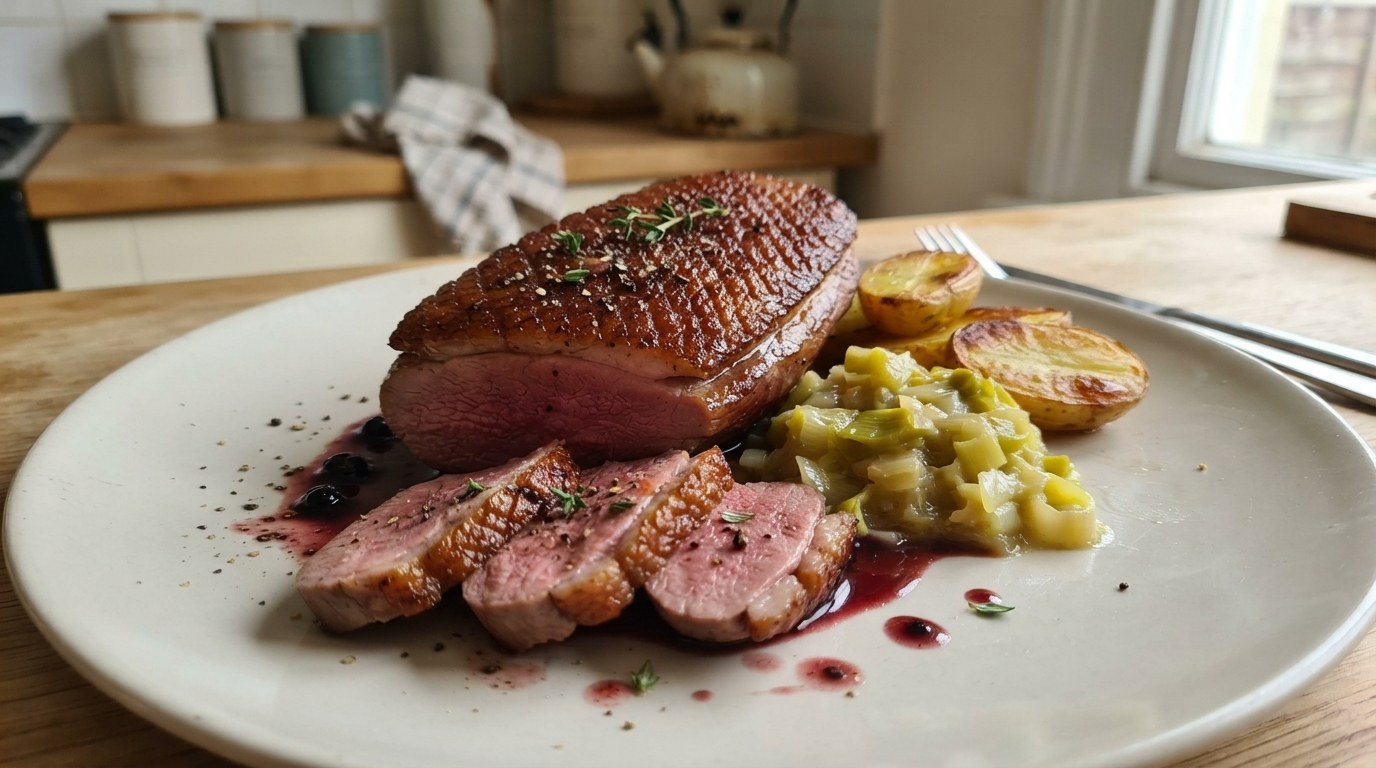
Crispy Duck Breast with Red Wine Blackcurrant Sauce (Gordon Ramsay's Method)
Ingredients
- For the duck
- 4 skin-on duck breasts, 6 to 8 oz each
- kosher salt and freshly ground black pepper
- For the sauce
- ¾ cup dry red wine
- 2 cloves garlic, skin on, lightly crushed
- 3 sprigs thyme
- ¾ cup duck or chicken stock
- 3 tbsp blackcurrant jam or conserve
- 2 tbsp cold unsalted butter, cubed
- For the creamed leeks
- 2 large leeks, white and pale green parts, sliced and washed
- 1 tbsp unsalted butter
- 1 clove garlic, crushed
- ¾ cup heavy cream
- For the confit potatoes
- 1 lb fingerling potatoes
- 1 shallot, halved
- 1 clove garlic, crushed
- 6 sprigs thyme
- olive oil or rendered duck fat, to cover (about 2 cups)
Instructions
- Confit potatoes: put the potatoes, shallot, garlic and thyme in a small saucepan, cover with oil, and bring to the barest simmer over medium-low heat. Cook until a knife slides in easily, 30 to 35 minutes. Leave them in the oil until needed, then lift out, halve lengthwise and season.
- Score the duck skin in a crosshatch at ¼-inch intervals, cutting through the skin and fat but not the meat. Season generously with salt and pepper on both sides (for the crispest skin, salt the night before and refrigerate uncovered on a rack). Pat the skin dry.
- Sauce: boil the wine with the garlic and thyme in a small pan until reduced by half, 7 to 8 minutes. Add the stock and reduce by half again, 6 to 8 minutes. Strain into a clean pan and keep warm.
- Leeks: melt the butter in a saucepan over medium-low heat, add the leeks, garlic and a pinch of salt, cover and cook, stirring now and then, until soft and collapsed, 10 to 12 minutes. Add the cream and simmer uncovered until thick, 4 to 5 minutes. Season and keep warm.
- Heat the oven to 400°F. Lay the duck breasts skin side down in a cold, dry, ovenproof skillet and turn the heat to medium-low. Render without moving them, pouring the fat off into a jar as it collects, until the fat layer is thin and the skin deep golden, 10 to 15 minutes. Raise the heat to medium for 2 to 3 minutes to crisp the skin fully, then turn the breasts and cook the flesh side 1 to 2 minutes.
- Turn the breasts skin side up and transfer the pan to the oven for 4 to 6 minutes, until a thermometer in the thickest part reads 130 to 135°F for medium-rare. Rest on a warm plate, skin side up, 5 to 10 minutes.
- While the duck rests, crisp the halved potatoes cut side down in a hot skillet with a spoon of their oil, 2 to 3 minutes. Take the sauce off the heat, whisk in the jam and then the cold butter a cube at a time until glossy, and season. Do not let it boil again.
- Slice each breast across the grain into ½-inch slices and fan on warm plates with the leeks and potatoes. Spoon the sauce beside the duck, not over the skin, and serve at once.
Notes
Crispy Duck Breast FAQs
The questions that come up most: how to get the skin crispy, why the pan starts cold, why the skin came out rubbery, whether duck breast has to be fully cooked, what temperature to pull it at, whether it can be finished in the oven or an air fryer, what sauce and sides go with it, and how to store leftovers.
How do you get crispy skin on duck breast?
Score the skin in a quarter-inch crosshatch without cutting the meat, salt it and dry it (overnight uncovered in the refrigerator is best), then lay it skin side down in a cold, dry pan and turn the heat to medium-low. Render 10 to 15 minutes, pouring off the fat as it collects, until the fat layer is thin and the skin deep golden, then raise the heat briefly to crisp it. Wet skin and a hot pan are the two things that stop it.
Why does duck breast start in a cold pan?
So the fat melts before the skin browns. Duck fat liquefies at a lower temperature than the skin browns, and a slow start gives it 10 to 15 minutes to run out through the score lines; the skin then fries thin and crisp in its own fat. In a hot pan the skin browns and seals in minutes while the fat underneath stays solid and rubbery.
Why is my duck skin rubbery instead of crisp?
The fat did not render. Usual causes: the skin was not scored, the pan started hot, the skin was wet, or the breast was turned too soon. Score a quarter-inch crosshatch, dry the skin, start cold, and leave the breast skin side down until the fat layer has visibly thinned, 10 to 15 minutes, pouring the fat off as it collects.
Does duck breast have to be fully cooked?
The USDA lists 165°F for all poultry with no exception for duck, and a breast cooked to that reading is safe and grey. Chefs, Ramsay included, serve duck breast at medium-rare, 130 to 135°F pulled and about 140°F after resting, treating the dense red muscle like a steak. Follow the USDA figure for anyone pregnant, elderly or immunocompromised; otherwise cook to 135°F and rest it.
What temperature should duck breast be?
Pull it at 130 to 135°F in the thickest part for medium-rare and rest 5 to 10 minutes; carryover brings it to about 140°F, rosy pink through the center. Maple Leaf Farms gives 140°F for medium. Use a probe thermometer; the springiness test in older recipes is a guess.
Can I cook duck breast in the oven or an air fryer?
The oven finish is part of this recipe: render the skin in the pan first, then 4 to 6 minutes at 400°F. An oven or air fryer alone cannot render the fat properly from cold; the hot air browns the skin before the fat has melted. If using an air fryer, render skin side down in a pan for 10 minutes first, then finish at 400°F for 4 to 6 minutes, checking with a thermometer.
What sauce and sides go with crispy duck breast?
Fruit against the fat: this page's red wine and blackcurrant sauce, or cherry, orange or a green peppercorn sauce. Sides that carry the sauce: creamed leeks, confit or roast potatoes, celeriac or parsnip purée, wilted greens, braised red cabbage. Pour a Pinot Noir or a Beaujolais.
Can I make duck breast ahead, and how do I store leftovers?
The sauce, leeks and confit potatoes can all be made a day ahead; the duck cannot, though it can be scored and salted the night before, which improves it. Leftover duck keeps three days and is best sliced cold or barely warmed, since reheating fully overcooks it. Keep the confit potatoes in their oil and the rendered fat for roasting.

About the Author
John Siracusa is the founder of Hell’s Kitchen Recipes. He focuses on technique-first, reproducible home cooking and researches recipes & kitchen equipment from published food science and professional chef methods since 2016.