This chicken stir fry with rice noodles is the fast one Gordon Ramsay cooks on his Ultimate Cookery Course: chicken breast flattened thin and seared hot, garlic fried until golden, broccolini, a splash of soy, two eggs and wide flat rice noodles, finished with lime. It takes about 35 minutes, and most of that is the noodles soaking. The two things that decide whether it turns out great or gluey are how you prepare the noodles and how much you put in the pan at once.
Gordon Ramsay's Chicken Stir Fry with Rice Noodles
Gordon Ramsay made this chicken stir fry with rice noodles in "Real Fast Food", episode 9 of Gordon Ramsay's Ultimate Cookery Course (2012), alongside a noodle soup with poached eggs and stir-fried pork noodles. His YouTube channel later posted the clip as Egg-Fried Rice Noodles with Chicken, and the point he makes there is that a breast tenderized thin and cooked very fast stays moist.
His method is short. According to a Simply Recipes walkthrough of the video, he butterflies the breast, flattens it with a rolling pin and slices it thin, sears it in a hot wok and seasons it, then adds sliced garlic until it turns golden and crisp, followed by broccolini until it looks shiny and a tablespoon or two of soy sauce. Everything comes out, the pan gets wiped, and the beaten eggs go into fresh oil before the noodles and chicken are tossed back through. Lime goes on at the table. This version keeps that order and those flavors. What changes is the detail a home kitchen needs: soaked noodles, the chicken in two batches, and amounts for four.
How to Soak Rice Noodles for Stir Fry (and Why Boiling Makes Them Gluey)
For a rice noodle stir fry, soak dried wide rice noodles in water that has just boiled, off the heat, for 8 to 12 minutes, until they bend easily but still have a firm bite. Then drain them, rinse under cold water and toss them with a teaspoon of oil. America's Test Kitchen found that boiled rice noodles stick together and turn soggy and clumpy, and gives 8 to 15 minutes in hot water for thick flat noodles versus about 5 for thin round ones. The flat ones are meant to finish softening in the pan.
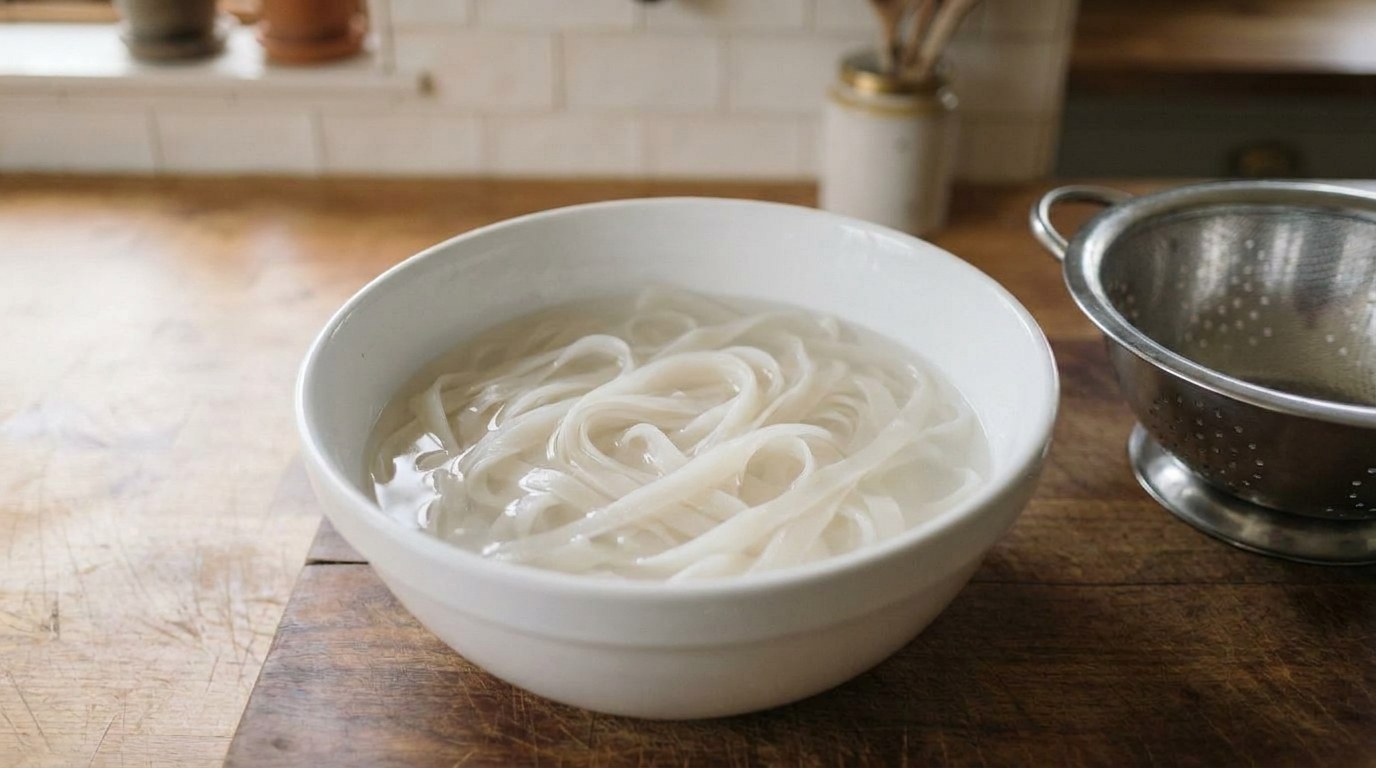
The reason is starch. Rice noodles are just rice flour and water, with no gluten, so each strand is held together by nothing but a starch gel. Rice starch softens and swells once the water passes about 150°F (65°C), which is why cold water takes the better part of an hour while just-boiled water does it in about ten minutes. A rolling boil overshoots: the outside of the noodle swells past the point where it holds together, sheds starch into the water and onto its own surface, and that loose gelatinized starch is the glue that welds the noodles into a clump. Overcooked rice noodles are also fragile and tear the moment you toss them.
Rinsing washes the loose starch off the surface, and a little oil after draining keeps the strands apart. Oil in the soaking water does nothing, since it floats on top. Pull the noodles while they are still slightly firm. They spend another two minutes in the pan picking up egg and soy, and a noodle that was already soft before it went in is mush by the time it comes out.
| Rice noodle | What it looks like | How to prep it | Use it for |
|---|---|---|---|
| Wide flat (rice stick, ho fun style) | Ribbons about 3/8 in to 1/2 in wide | Just-boiled water off the heat, 8 to 12 min; rinse cold, drain, oil | This recipe; pad see ew-style stir fries |
| Medium flat (pad thai) | About 1/4 in wide | Hot water off the heat, 6 to 8 min; rinse | Pad thai and lighter stir fries |
| Thin round (vermicelli, rice sticks) | Fine strands | Hot water about 5 min; rinse | Salads, noodle bowls, summer rolls, Singapore-style noodles |
| Fresh wide rice noodles | Soft, oily sheets or ribbons, sold chilled | No soak; separate the strands by hand and add them straight to the pan | Chow fun; swap 1 1/2 lb fresh for the 8 oz dried here |
Wide flat noodles are the ones Ramsay used, and they suit this dish best because their broad surface catches the egg and soy. Thin vermicelli works in a pinch but breaks up in a hard toss.
Why Ramsay Flattens the Chicken Breast
Flattening the chicken breast gives every strip the same thickness, so all of it is done at the same moment. A whole breast is thick at one end and thin at the other, and when you slice it as it is, the thin pieces dry out while the thick ones are still raw in the middle. Butterfly the breast by slicing it almost in half through the side, open it like a book, cover it with plastic wrap and roll or pound it to an even 1/2 inch, then slice it across into strips about 1/4 inch thick.
Breast meat has almost no fat or connective tissue to protect it. Its proteins tighten between about 122 and 140°F (50 to 60°C), and as the collagen contracts it squeezes out juice, so every degree past done costs moisture. Cook chicken to 165°F (74°C), the USDA safe minimum internal temperature for poultry, and stop there. Thin strips get there in 2 to 3 minutes; check the thickest piece with an instant-read thermometer, or cut it open and make sure it is white all the way through.
A teaspoon of cornstarch tossed through the strips with a splash of the soy is optional, and it is a small upgrade on Ramsay's version. The thin coating turns to a film on the hot metal that browns quickly and shields the surface while the inside cooks, and the soy and egg cling to it later. The soy itself only seasons the outside: salt is the one part of a marinade that travels deep into meat, and five minutes is plenty for that.
High Heat, Small Batches: Searing the Chicken for a Rice Noodle Stir Fry
Cook the chicken for a rice noodle stir fry in two batches in a very hot pan, so it sears instead of stewing. Browning, the Maillard reaction, happens once the surface of the meat passes about 285°F (140°C), according to the science of the Maillard reaction. Raw chicken releases water as it heats, and water can't get hotter than 212°F (100°C), so a pan packed with a pound of chicken drops in temperature, fills with juice and boils the meat grey. Ramsay's rule for chicken in a pan is the same one: if it doesn't sizzle when it goes in, it boils. Half the chicken at a time, spread in one layer and left alone for a minute, comes out golden.
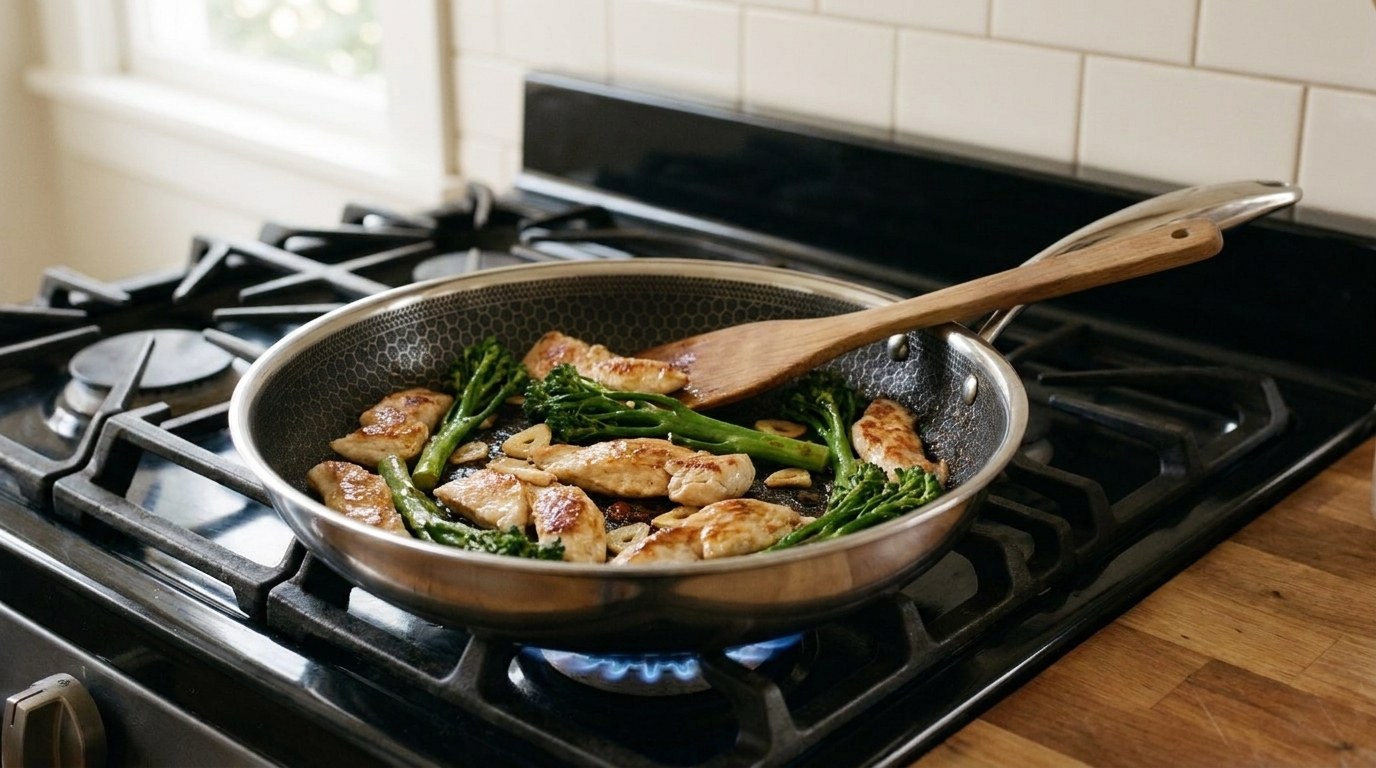
Heat the empty pan first, then add a high-smoke-point oil such as grapeseed, which Ramsay uses for meat and chicken. Once the second batch of chicken is seared, lower the heat to medium and add the garlic. Thin slices of garlic go from golden to burnt in seconds, and burnt garlic tastes acrid and bitter because it is past about 356°F (180°C), where browning turns into scorching. Pull the heat back the moment the edges turn light gold. Broccolini halved lengthwise cooks through in about 2 minutes; a tablespoon of water under it steams the thick stalks without washing out the pan.
Skillet or Wok for a Chicken Stir Fry with Rice Noodles?
A 12-inch skillet works as well as a wok for a chicken stir fry with rice noodles on a home stove, and often better. A round-bottomed wok touches a flat home burner at one small spot, while a flat skillet sits with its whole base over the flame, so more of the pan is hot enough to brown. A wok shines on a restaurant burner that wraps flame up its sides; on a home range, the wide, flat surface matters more. The other thing that helps with rice noodles is a non-stick surface, because their starch grabs bare steel. Our Gordon Ramsay cookware guide compares the pans he uses.

HexClad
HexClad 12-Inch Hybrid Nonstick Frying Pan
- Stainless steel and ceramic nonstick hybrid surface, built to sear hard and release easily
- Tri-ply with an aluminum core for quick, even heat; works on induction
- Oven safe to 900°F and metal-utensil safe (lid not included)
The Eggs and the Final Toss
Scramble the eggs in the wiped pan, then add the noodles straight on top of them so the soft egg breaks up and coats the strands. Egg proteins begin to set at about 140°F (60°C), so in a hot pan the eggs need only 20 to 30 seconds before the noodles go in; they finish cooking as you toss. Wiping the pan first matters. The dark soy and garlic bits left from the chicken would burn under the eggs, and a clean pan lets the noodles pick up a little toasted color of their own.
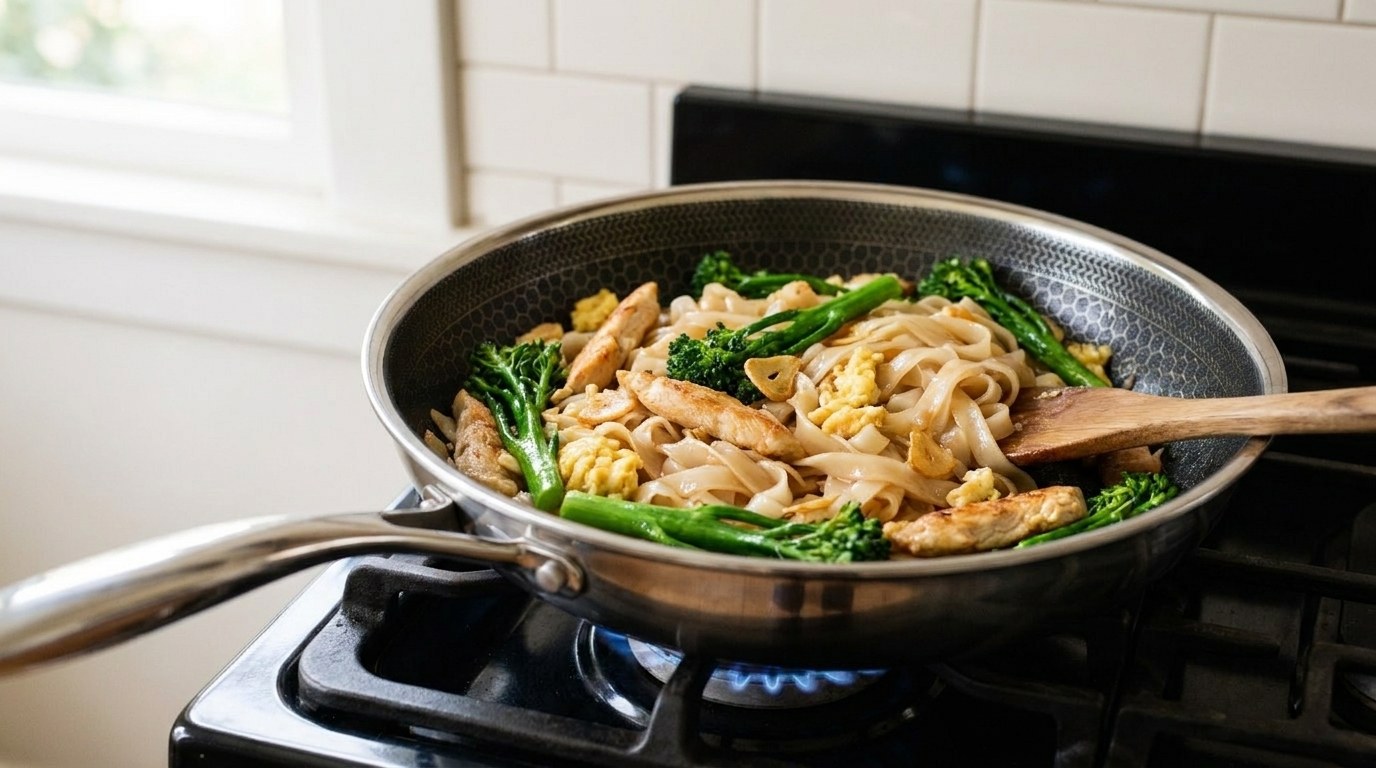
Add the noodles last, after the eggs, and toss for 1 to 2 minutes until hot and lightly glossy, then return the chicken and broccolini with the rest of the soy. If the noodles look dry or start to stick, add a tablespoon of water rather than more soy; they absorb it and loosen without getting saltier. Taste before you add salt, the way Ramsay always does, because soy sauce brings most of the seasoning. Squeeze lime over at the table so its acidity stays bright.
Ramsay's fragrant fried rice from the same series follows the same logic of a hot pan, small amounts and eggs cooked soft; see our Gordon Ramsay egg fried rice for the rice version.
Variations
The base recipe is plain on purpose, so it takes extras well. For heat, stir a spoonful of Gordon Ramsay chilli jam into the soy, or add a sliced red chilli with the garlic. For a deeper sauce, swap 1 tablespoon of the soy for oyster sauce. Bok choy, snap peas or sliced cabbage can replace the broccolini; add them for the same 2 minutes. Shrimp works in place of chicken and needs about 1 minute a side, and boneless thighs sliced the same way are more forgiving than breast.
To make it gluten-free, check the soy sauce. The rice noodles are naturally gluten-free, but the Celiac Disease Foundation lists traditional soy sauce as a source of gluten because it is brewed with wheat; tamari made without wheat is the swap.
Why Is My Chicken Stir Fry with Rice Noodles Sticky or Mushy?
Sticky, mushy rice noodles nearly always mean they were boiled or soaked too long, or not rinsed. Soak them in water off the heat until just pliable, rinse until the water runs clear, and oil them. Noodles that weld into one lump in the pan were usually drained and left to sit, so toss them with the oil straight after draining. Noodles that snap into short pieces were overcooked before they went in, or got tossed hard with tongs; fold them gently with a spatula.
Grey, rubbery chicken means the pan was crowded or not hot enough. Dry chicken means it went too long; thin strips need only minutes. Bland? Add soy a teaspoon at a time and finish with lime. Too salty usually comes from salting the chicken and then adding the full amount of soy, which is why this recipe salts nothing until the end.
Storing and Reheating Chicken Stir Fry with Rice Noodles
Refrigerate leftover chicken stir fry with rice noodles within 2 hours and eat it within 3 to 4 days, reheating it to 165°F, as the USDA advises in its leftovers guidance. The noodles will be firm and a little brittle straight from the fridge. That is retrogradation: as cooked starch cools, it slowly recrystallizes and hardens, the same process that stales bread. Reheat in a skillet with a tablespoon or two of water over medium heat, covered for a minute, then toss until steaming. The water softens the starch again. Microwaving works with a damp paper towel over the bowl.
You can soak the noodles up to a few hours ahead if you rinse and oil them well and keep them covered in the fridge, but the stir fry itself is best cooked just before you eat. For more weeknight chicken dinners, try the one-pan Gordon Ramsay chicken and rice, the chicken noodle soup from scratch or our list of the best Gordon Ramsay chicken recipes. Get the noodles right and this chicken stir fry with rice noodles is on the table in the time it takes the water to cool.
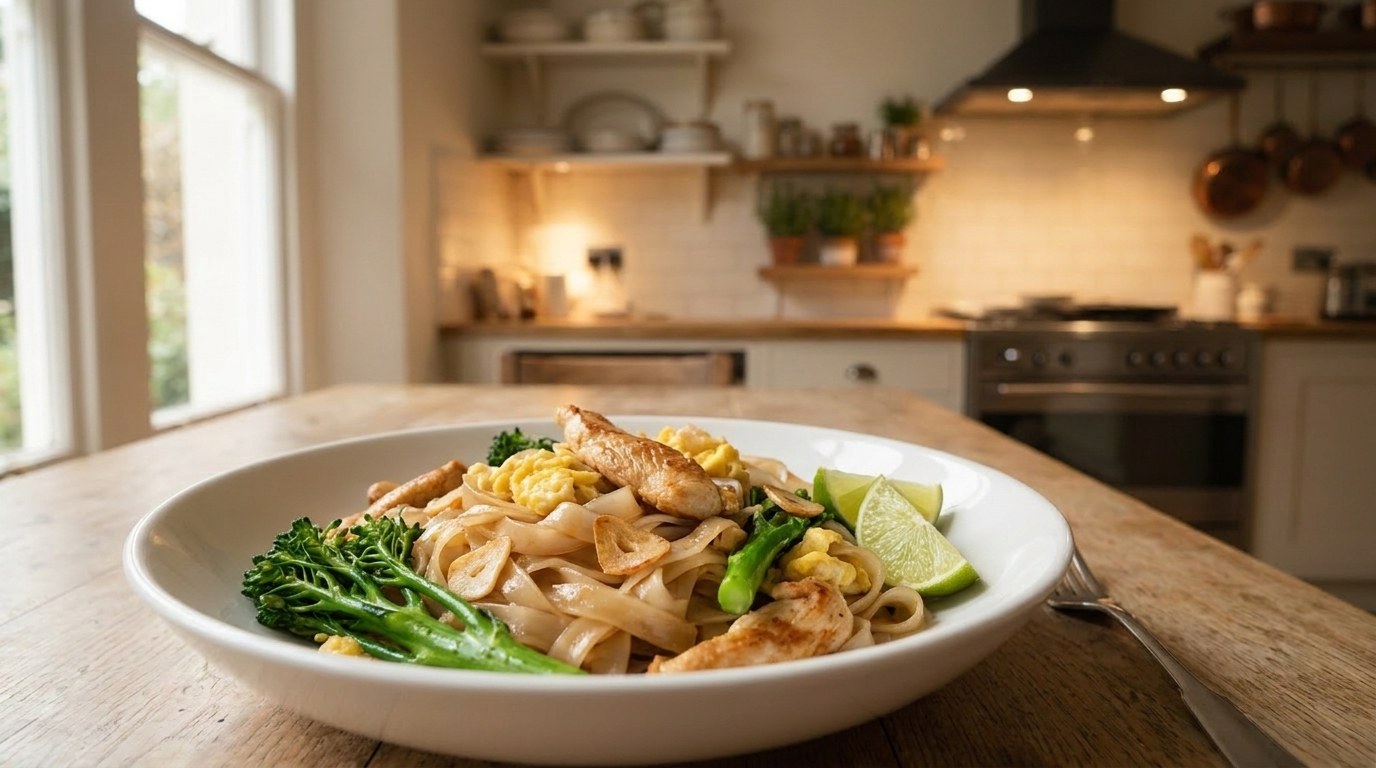
Chicken Stir Fry with Rice Noodles
Ingredients
Noodles
- 8 oz dried wide flat rice noodles (about 3/8 inch wide), or 1 1/2 lb fresh wide rice noodles
- 1 tsp grapeseed or other neutral oil, for tossing the noodles
Chicken
- 1 1/4 lb boneless, skinless chicken breasts (2 large)
- 1 tsp cornstarch (optional)
- 3 tbsp soy sauce, divided (or gluten-free tamari)
- 3 tbsp grapeseed oil, divided
- 4 garlic cloves, thinly sliced
- 8 oz broccolini, trimmed and halved lengthwise
To finish
- 2 large eggs, beaten
- 1/2 tsp freshly ground black pepper
- salt, to taste (only if needed)
- 1 lime, cut into wedges
Instructions
- Put the noodles in a large heatproof bowl. Bring a kettle or pot of water to a boil, take it off the heat and pour it over the noodles to cover. Soak 8 to 12 minutes, stirring once, until they bend easily but are still slightly firm. Drain, rinse under cold running water until it runs clear, drain well and toss with the 1 teaspoon oil.
- While the noodles soak, butterfly each chicken breast by slicing it almost in half through the thick side and opening it out. Cover with plastic wrap and roll or pound to an even 1/2 inch. Slice across into strips about 1/4 inch thick. Toss with the cornstarch (if using) and 1 teaspoon of the soy sauce.
- Heat a 12-inch skillet or wok over high heat until very hot, then add 1 tablespoon of the oil. Add half the chicken in a single layer; it should sizzle loudly. Leave it for 1 minute, then stir-fry 1 to 2 minutes more until golden and cooked through (165°F in the thickest strip). Move to a plate. Repeat with another 1 tablespoon oil and the rest of the chicken.
- Lower the heat to medium. Add the garlic to the oil left in the pan and stir for 30 to 60 seconds, just until light golden. Add the broccolini and 1 tablespoon water and stir-fry about 2 minutes, until bright green, glossy and just tender. Return the chicken, add 1 tablespoon of the soy sauce, toss, and tip everything onto the plate.
- Wipe out the pan with paper towels and set it back over medium-high heat with the last 1 tablespoon oil. Pour in the eggs and let them set for 20 to 30 seconds, stirring gently, until barely set.
- Add the noodles on top of the eggs and toss for 1 to 2 minutes until hot and coated with egg. Return the chicken, garlic and broccolini with any juices, add the remaining soy sauce (about 1 1/2 tablespoons) and the pepper, and toss 1 minute more. Add a tablespoon of water if the noodles stick.
- Taste and add salt only if needed. Serve right away with lime wedges for squeezing over.
Notes
Chicken Stir Fry with Rice Noodles FAQs
The questions that come up most: whether Gordon Ramsay really made this dish, whether to soak or boil rice noodles, why rice noodles go sticky, when to add them, how long to cook the chicken, whether it is gluten-free, how to reheat it, and how many noodles to cook per person.
Did Gordon Ramsay make a chicken stir fry with rice noodles?
Yes. Chicken stir fry with rice noodles is one of the dishes in "Real Fast Food", episode 9 of Gordon Ramsay's Ultimate Cookery Course (2012), and his YouTube channel posted the clip as Egg-Fried Rice Noodles with Chicken. He flattens and thinly slices chicken breast, sears it with garlic and broccolini, adds soy, scrambles two eggs, tosses in wide rice noodles and finishes with lime.
Should you soak or boil rice noodles for stir fry?
Soak them. Pour just-boiled water over dried wide rice noodles off the heat and leave them 8 to 12 minutes, until pliable but still firm, then rinse under cold water and toss with a little oil. Boiling overcooks the outside, so the noodles stick together and break apart in the pan.
Why are my rice noodles sticky?
Loose starch on the surface. Boiling, over-soaking or skipping the rinse leaves gelatinized starch on the noodles, and it glues them together. Rinse until the water runs clear, toss with oil right after draining, and add them to the pan last.
When do you add rice noodles to a stir fry?
Last. Cook the chicken and vegetables, take them out, scramble the eggs, then add the soaked noodles and toss for 1 to 2 minutes before the chicken, vegetables and soy go back in.
How long do you stir-fry chicken strips?
About 2 to 3 minutes per batch for strips 1/4 inch thick, in a very hot pan, until they are golden and reach 165°F inside. Cook a pound in two batches so the pan stays hot.
Is chicken stir fry with rice noodles gluten-free?
The rice noodles are, but regular soy sauce is brewed with wheat and contains gluten. Use a tamari labeled gluten-free and check the noodle package for a gluten-free label if cross-contact matters.
Can you reheat a rice noodle stir fry?
Yes. Refrigerate it within 2 hours, eat it within 3 to 4 days, and reheat it to 165°F in a skillet with a splash of water, covered for a minute, so the firm noodles soften again.
How much rice noodles per person?
About 2 ounces of dried rice noodles per person for a main course with chicken and vegetables, so 8 ounces serves four. Make 3 ounces each for big appetites.

About the Author
John Siracusa is the founder of Hell’s Kitchen Recipes. He focuses on technique-first, reproducible home cooking and researches recipes & kitchen equipment from published food science and professional chef methods since 2016.