Gordon Ramsay's scrambled eggs are soft, glossy and barely set, and the whole method is built to keep them that way: the eggs go into a cold nonstick pan with a knob of butter, un-whisked and un-seasoned, and cook on and off the heat while you stir constantly, so they never get hot enough to seize. He pulls the pan while the eggs still look a touch too loose, stirs in a spoon of crème fraîche to stop the cooking dead, and seasons only then. No milk, no water, no whisking the eggs to a froth first. That is the version on his own restaurant site and the one he demonstrates in nearly every class, and it is the reason his eggs are creamy where most home scrambled eggs are dry.
What follows is why each of those moves works, so you can hit it every time instead of hoping: why the cold pan and the off-the-heat stirring give you small, silky curds, why milk is the thing making your eggs watery, why salt belongs at the end and not the beginning, and how the crème fraîche does more than add richness. For his no-pre-beat variation see the no-whisk scrambled eggs walkthrough, and if breakfast is turning into brunch, the same soft-egg habit carries into eggs Benedict.
What Makes Gordon Ramsay's Scrambled Eggs Different
Three things, and they all point the same way: keep the eggs from overcooking. First, the pan starts cold and the eggs and butter go in together, so the eggs warm slowly and evenly instead of gripping a screaming-hot surface. Second, the pan comes off the heat every 20 to 30 seconds while you keep stirring, which holds the eggs in the narrow window where the proteins have just set into soft curds but have not squeezed out their water. Third, they come off the stove underdone and finish on carryover heat, cut short by a spoon of cold crème fraîche. Most home recipes do the opposite: hot pan, whisked eggs with milk, salt up front, and cooked until they look done, by which point they are already past it.
The payoff is texture. Ramsay's eggs are a loose custard of tiny curds, not the large, firm, weepy flakes you get from a hot pan. The technique is closer to making a custard than frying, which is exactly how he describes it, and it is why the same low-and-slow, keep-it-moving idea shows up in his MasterClass lessons on eggs.
The Cold-Pan, Off-the-Heat Method
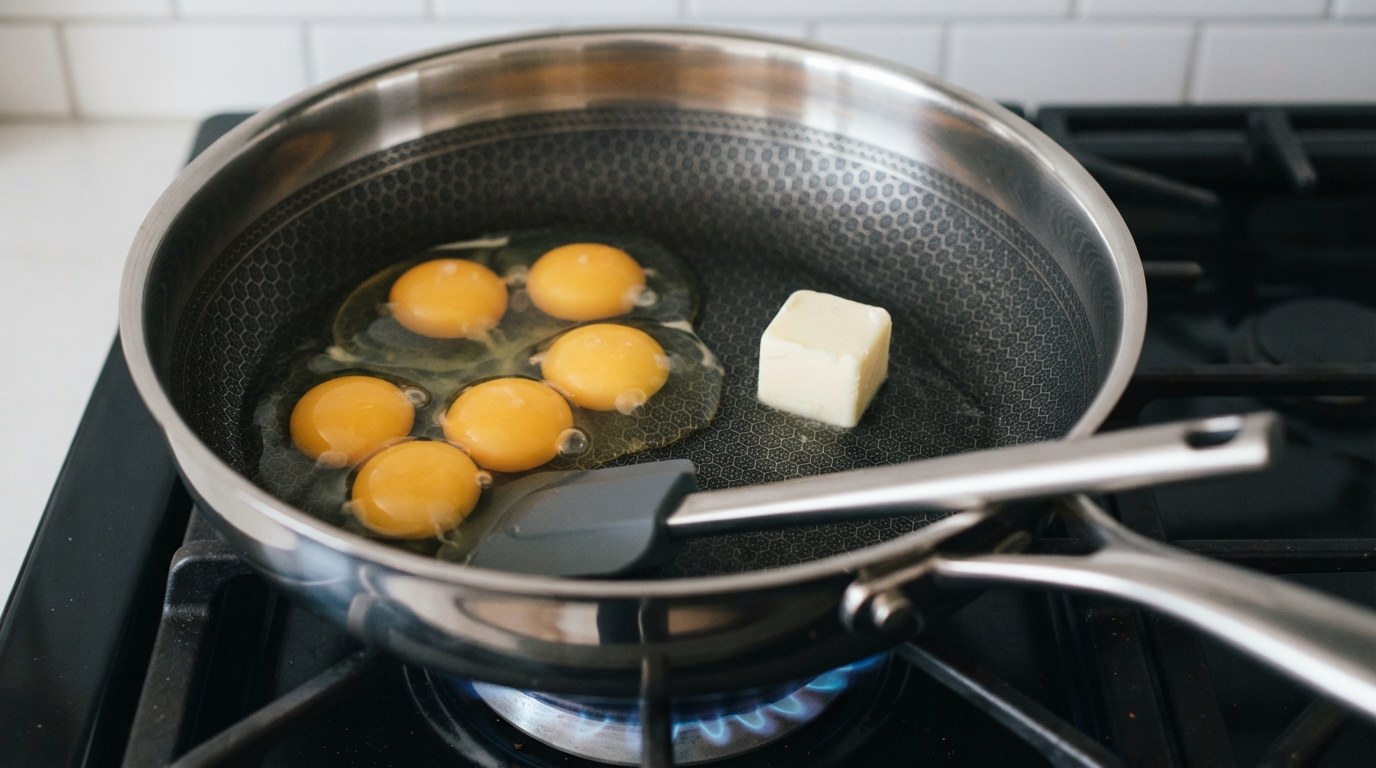
Crack the eggs straight into a cold nonstick pan, add a generous knob of butter, and do not whisk or season them yet. Put the pan over high heat and start stirring right away with a rubber spatula, scraping the bottom and corners so nothing sets in a sheet. After about 30 seconds, when the first curds form on the base, lift the pan clean off the heat and keep stirring for 10 seconds, then set it back on. Repeat that on-off rhythm; the whole thing takes two to three minutes for six eggs. You are chasing soft, small curds bound in loose, still-glossy egg, and you stop while it looks slightly underdone.
The reason the pan comes off the heat is temperature control. Egg proteins begin to firm at around 140°F/60°C and, left on direct high heat, race straight past that into tight, rubbery curds that wring out their own moisture, which is the puddle of grey liquid on the plate. Pulling the pan every 20 to 30 seconds lets the residual heat keep cooking the eggs gently without ever spiking them, and constant stirring breaks the setting egg into fine curds instead of one thick sheet. It is the same principle as a stovetop custard: gentle heat, never stop moving, take it off before it looks fully set because it carries on cooking in the pan.
Do You Add Milk to Scrambled Eggs? No, and Here Is Why
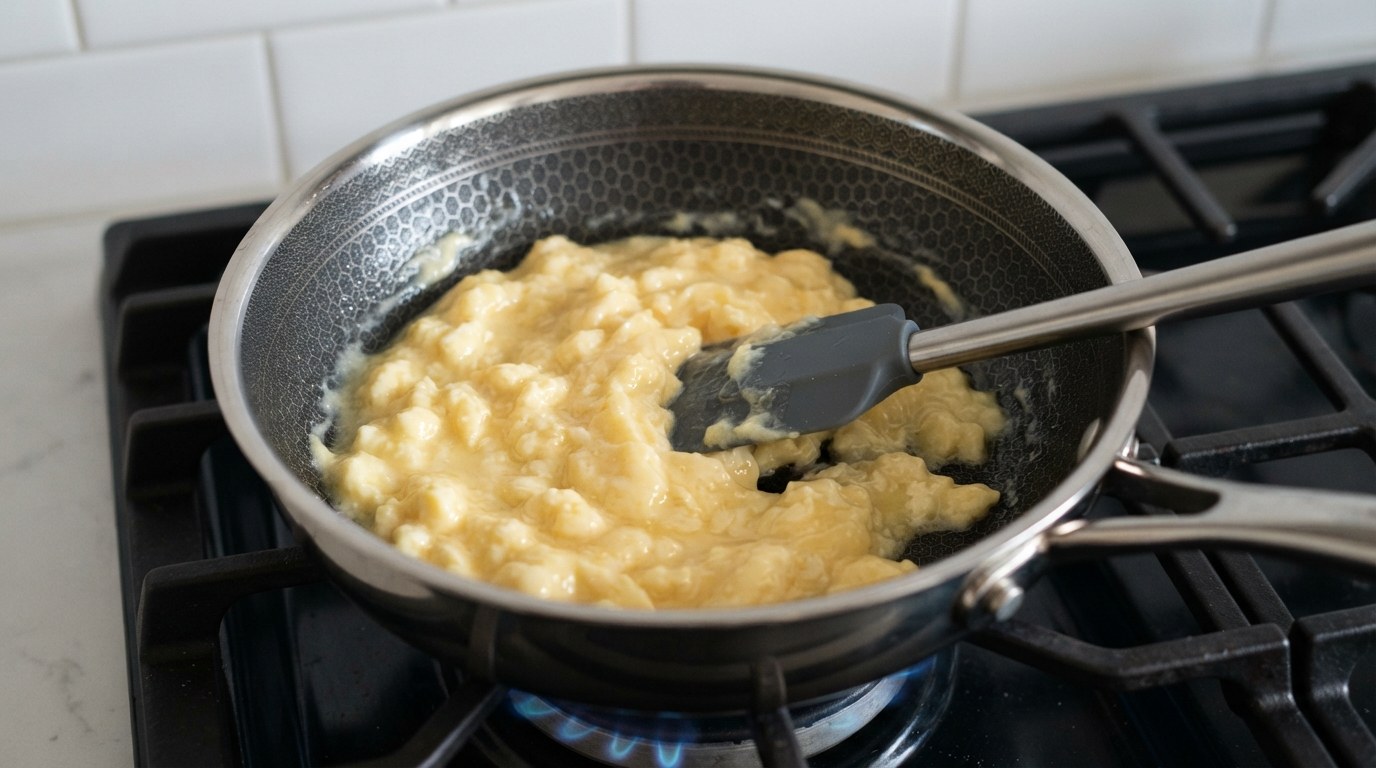
Ramsay does not add milk or water to his scrambled eggs, and he is right to skip it. Milk and water thin the egg and, because they are mostly water, they turn to steam and weep out as the eggs cook, leaving them watery and pale rather than rich. People add milk hoping for softness, but softness comes from not overcooking the eggs, not from diluting them. The richness in his version comes from fat instead: butter in the pan and a spoon of crème fraîche at the end.
The crème fraîche is the clever part. It works where a splash of milk fails because of its fat: at around 30 percent fat, crème fraîche is heat-stable and folds into hot eggs without splitting, while low-fat dairy would just water them down. Stirred in cold, off the heat, it also drops the temperature of the eggs on contact and stops the carryover cooking in its tracks, which is why it doubles as both the richness and the brake. No crème fraîche in the fridge? A knob of cold butter or a spoonful of mascarpone does the same job.
When to Season: Salt at the End, Never the Start
Season the eggs only once they are off the heat and plated up, never before they cook. Salt draws water out of the beaten egg, and if it sits on raw eggs it starts breaking them down and turns them grey and loose by the time they hit the pan. Added at the end, the salt seasons without that damage and the eggs stay a bright, pale yellow. The same goes for pepper, which can turn dull and dusty if it cooks. This is one of the most common scrambled-egg mistakes, and fixing it costs nothing.
| The usual way | What it does | Ramsay's move |
|---|---|---|
| Hot pan, then the eggs | Base sets instantly into a firm sheet; curds turn large and dry | Cold pan, eggs and butter in together, warm up slowly |
| Whisk in milk or cream first | Water thins the egg and weeps out as steam; pale, watery result | No milk; richness from butter and crème fraîche |
| Salt the raw eggs | Salt draws water out and greys the eggs before they cook | Season only at the very end, off the heat |
| Leave the pan on the heat | Eggs blow past 140°F/60°C into rubber and squeeze out liquid | On and off the heat every 20–30 seconds |
| Cook until they look done | Carryover heat pushes them past done on the plate | Pull while still loose; crème fraîche stops the cooking |
The Crème Fraîche Finish, and What to Serve Them On
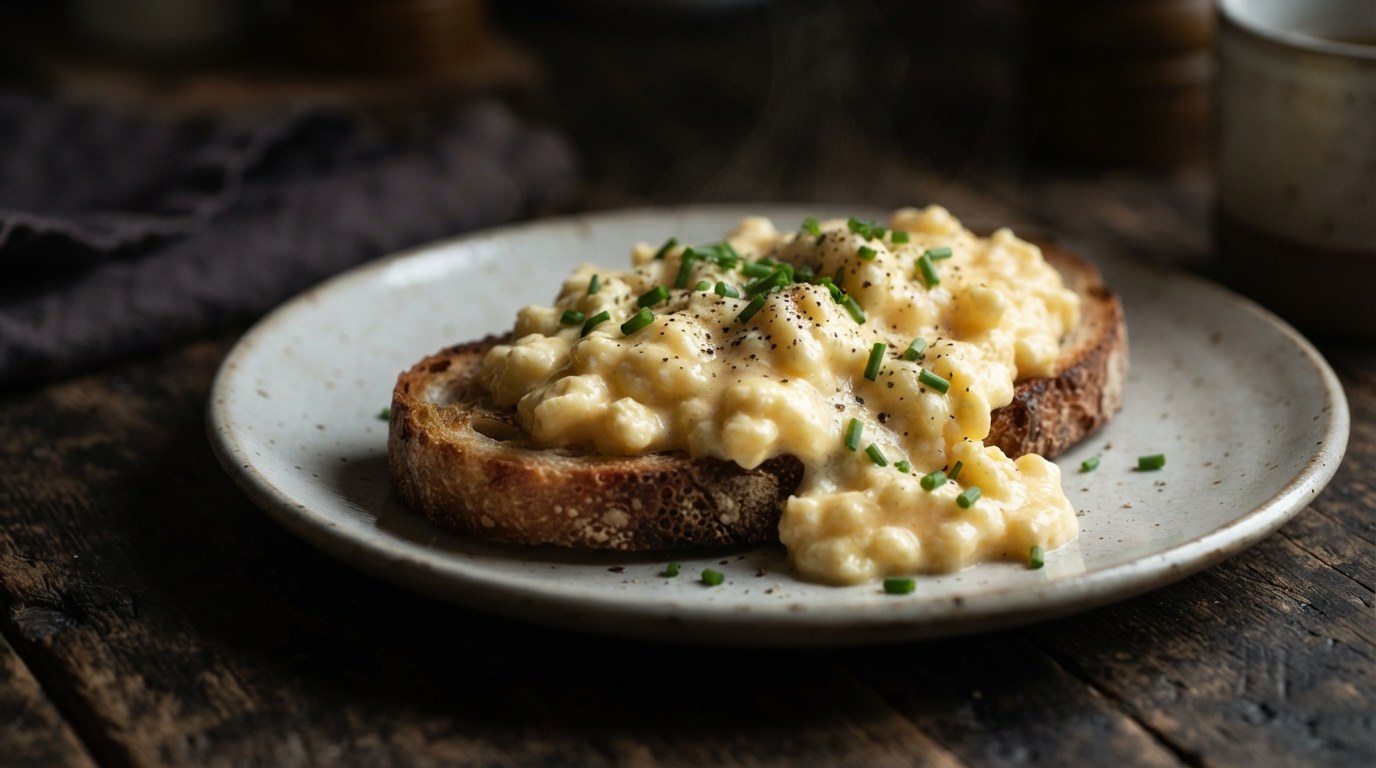
The instant the eggs are almost there, take the pan off the heat, stir in a heaped teaspoon of crème fraîche, then season with sea salt and freshly ground black pepper and a scatter of finely chopped chives. Serve them immediately; scrambled eggs wait for no one, and a warm plate buys you a few extra seconds. Ramsay serves his on thick, toasted sourdough, often alongside slow-roasted tomatoes and sautéed mushrooms, or with smoked salmon for a classic pairing. The bread matters more than it sounds: a sturdy, chewy slice holds the loose eggs where thin white toast goes soggy.
If you want to gild it the way he does on special occasions, a few shavings of fresh truffle or a spoon of trout roe over the top is the restaurant finish. For everyday, the chives and good bread are plenty. And cook them to eat, not to hold: unlike a stew, eggs cannot be kept warm, because they keep setting and toughen within a minute or two of leaving the pan.
Scrambled Egg Doneness and Timing
| Stage | What you see | Why |
|---|---|---|
| Eggs and butter in the cold pan | Butter softening, eggs still whole and un-whisked | A slow start means an even, gentle cook |
| ~30 seconds on high heat | First soft curds forming on the base | This is when the on-off stirring begins |
| 2 to 3 minutes, stirring on and off | Small glossy curds in loose, shiny egg | Held just at the 140°F/60°C setting point, never past it |
| Pull the pan | Looks slightly underdone and wet | Carryover heat finishes them on the plate |
| Crème fraîche stirred in off the heat | Eggs tighten to a soft custard, glossy not dry | Cold fat stops the cooking and adds richness |
| Food-safe endpoint (if needed) | 160°F/71°C | The USDA-safe temperature for eggs; soft-set eggs are for healthy adults, not the vulnerable |
The clock is a guide; your eyes decide. Bigger eggs, a heavier pan or a cold stovetop all stretch the time, so judge by the curds, not the minutes. If you are cooking for someone pregnant, very young, elderly or unwell, the USDA guidance is to cook eggs until both white and yolk are firm, or to 160°F/71°C, which means giving up the soft set. For everyone else, soft and glossy is the goal.
Troubleshooting, Variations and Scaling
Watery eggs mean either milk went in or they overcooked and wept; drop the milk and pull them sooner. Rubbery eggs are simply overdone, so take the pan off the heat earlier and lean harder on the crème fraîche and carryover. Eggs that smell strongly of sulfur have been taken too far: that "eggy" smell is hydrogen sulfide, freed from the egg proteins once they pass about 140°F/60°C, and it is a sign to cook them softer next time. To scale up, keep the ratio at one knob of butter and one teaspoon of crème fraîche per two or three eggs, but do not crowd the pan; more than six or eight eggs cook unevenly, so use a wider pan or cook in batches.
For richer eggs, use two extra yolks in place of a whole egg. For a lighter plate, serve them with the American Egg Board's note in mind that fresh eggs hold together best, so buy them close to the date. Fold in soft herbs, a little grated Gruyère off the heat, or smoked salmon at the very end. The good nonstick pan and rubber spatula do a lot of the work here; the site's guide to the cookware Gordon Ramsay uses covers the pans that make eggs easy, and once you have the soft-curd habit, carry it into deviled eggs and the rest of the recipe collection.
Gordon Ramsay Scrambled Eggs (Soft and Creamy)
Ingredients
- 6 large eggs, cold
- 1 Tbsp unsalted butter (a generous knob)
- 1 heaped tsp crème fraîche (or cold butter/mascarpone)
- 1 Tbsp chives, finely chopped
- Sea salt and freshly ground black pepper, to season at the end
- 2 thick slices sourdough bread, toasted, to serve
Instructions
- Get everything ready first: toast the sourdough, chop the chives, and warm the plates. Scrambled eggs cook in minutes and cannot wait.
- Crack the eggs into a cold nonstick saucepan and add the butter. Do not whisk and do not season.
- Set the pan over high heat and stir constantly with a rubber spatula, scraping the bottom and corners.
- After about 30 seconds, as the first curds form, lift the pan off the heat and keep stirring for about 10 seconds, then return it to the heat. Repeat this on-off rhythm, stirring the whole time, for 2 to 3 minutes.
- When the eggs are soft, glossy and still look slightly underdone, take the pan off the heat for good. They will keep cooking from their own heat.
- Stir in the crème fraîche to stop the cooking and keep them creamy, then season with sea salt and pepper and most of the chives.
- Spoon straight onto the toasted sourdough, scatter with the remaining chives, and serve immediately.
Notes
Gordon Ramsay Scrambled Eggs FAQs
The questions that come up most: how Gordon Ramsay makes his scrambled eggs, whether he uses milk, when to season them, what crème fraîche does, why eggs turn out watery or rubbery, and how long they take.
How does Gordon Ramsay make scrambled eggs?
He cracks the eggs into a cold nonstick pan with a knob of butter, un-whisked and un-seasoned, then cooks them on high heat while stirring constantly, lifting the pan off the heat every 20 to 30 seconds so they never overcook. He pulls them while they still look slightly loose, stirs in a spoon of crème fraîche off the heat to stop the cooking, seasons with salt and pepper, adds chopped chives, and serves them on toasted sourdough.
Does Gordon Ramsay put milk in his scrambled eggs?
No. He uses no milk or water, because they thin the eggs and weep out as steam, leaving them watery. The richness comes from butter in the pan and a spoonful of crème fraîche stirred in at the end, which is heat-stable at about 30 percent fat and also stops the eggs cooking further.
Why do you take the pan off the heat?
To keep the eggs from overcooking. Egg proteins firm up at around 140°F/60°C and, left on direct heat, race past that into tough, weepy curds. Lifting the pan off the heat every 20 to 30 seconds while you keep stirring holds the eggs gently at the soft-set stage, so they stay creamy with small curds.
When should you season scrambled eggs?
At the very end, off the heat, never before cooking. Salt added to raw eggs draws out water and turns them grey and loose. Seasoned after cooking, the eggs stay bright and creamy, and the salt seasons without breaking them down.
What does crème fraîche do in scrambled eggs?
Two things. It adds richness without watering the eggs down the way milk does, because its roughly 30 percent fat keeps it from splitting in the hot eggs. And stirred in cold, off the heat, it drops the temperature and stops the carryover cooking, locking the eggs at soft and glossy. Cold butter or mascarpone works if you have no crème fraîche.
Why are my scrambled eggs watery or rubbery?
Watery eggs usually mean milk or water was added, or the eggs overcooked and wept out their moisture. Rubbery eggs are overcooked, full stop. Both are fixed the same way: skip the milk, keep the heat gentle by lifting the pan on and off, stir constantly, and pull the eggs while they still look a little underdone.
How long do Gordon Ramsay scrambled eggs take?
About two to three minutes for six eggs. It is quick, which is why everything has to be ready first: the toast made, the plate warm, the chives chopped. Because the eggs keep cooking off the heat, they are served the moment they leave the pan.
Should you whisk the eggs first?
Ramsay does not pre-whisk them; he cracks them whole into the pan with the butter and breaks them up as they cook, which gives a mix of white and yolk in soft curds. Whisking to a uniform froth first is fine too, but it is not part of his method. See the no-whisk scrambled eggs walkthrough for that exact approach.
About the Author
John Siracusa is the founder of Hell’s Kitchen Recipes. He focuses on technique-first, reproducible home cooking and researches recipes & kitchen equipment from published food science and professional chef methods since 2016.